
Maple Nut Crunch via Scoop Wholefoods
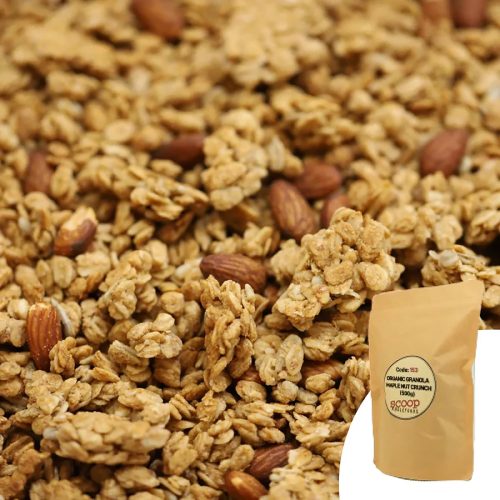
Australian Cereal Manufacturer Opera Foods have had a proud long association with Australia’s Scoop Wholefoods. Opera has been bulk supplying our premium Plum Foods brand “Maple Nut Crunch” vegan granola to their Scoop stores around Australia for many years. Scoop also regularly exports it to their Singapore store.
The Scoop Wholefood‘s mission is to have a positive impact on our environment. They offer a great range quality wholefood products in bulk supply with the least packaging use.
See below 500g pack of Maple Nut Crunch in Scoop’s plain packaging offered online by their Singapore store.
Scoop have also recently opened in Dubai and their brand and service endures to clients that appreciate good quality wholefoods.
For a perfect breakfast cereal. experience try Plum Food’s “Maple Nut Crunch” premium vegan granola
This article was reproduced on this site with permission from operafoods.com.au the “Vegan Granola Manufacturers”.
See original article:- Maple Nut Crunch via Scoop Wholefoods
Premium Granola Bowl Recipes with Maple Nut Crunch
What does it take to create a menu item that customers don’t just like, but actively rave about? It often comes down to one thing: exceptional quality. When you use an ingredient that has a story, a pedigree, and an award-winning taste, you’re not just serving food; you’re creating an experience.
I once spoke to a café owner in Melbourne who told me her breakfast sales shot up after she switched to a premium, locally made granola. Customers could taste the difference. They started asking what was in the granola bowl, and it became a real conversation starter. That’s the power of a standout ingredient. It can elevate a simple dish into something truly special.
If you’re looking to create that same “wow” factor on your menu, then this post is for you. We’re going to explore some premium granola bowl ideas using a truly exceptional product: Plum Foods’ Maple Nut Crunch. This isn’t just any granola; it’s one of the few Australian food products to win a Gold Medal at the prestigious Great Taste Awards. Let’s look at how you can use these award-winning granola recipes to set your café apart.
The Power of a Premium Ingredient
In a competitive market, every detail matters. Using a premium, award-winning granola like Maple Nut Crunch sends a clear message to your customers: you care about quality. It’s a talking point for your staff, a story for your social media, and a justification for a premium price point.
What makes Maple Nut Crunch so special?
- Award-Winning Taste: It’s internationally recognised for its flavour and texture.
- Wholesome Ingredients: It’s handmade in Australia with natural ingredients, including organic oats and Australian almonds.
- Vegan-Friendly: It’s made with plant-based ingredients, sweetened with maple and agave syrup, catering to a wide audience.
- Incredible Texture: It’s baked to create large, satisfyingly crunchy clusters that hold up perfectly in a bowl.
By building recipes around this star ingredient, you’re not just following healthy granola bowl trends; you’re setting a new standard.
Recipe 1: The “Gold Medal” Signature Bowl
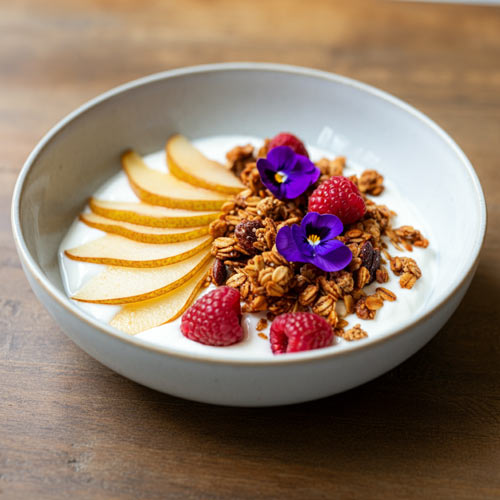
This recipe is designed to be your café’s signature dish. It’s elegant, sophisticated, and perfectly showcases the premium quality of the Maple Nut Crunch. It’s the kind of bowl that gets photographed and talked about.
Granola Spotlight: Plum Foods Maple Nut Crunch
The hero of our recipes. Its distinct maple aroma and nutty, crunchy texture provide the perfect gourmet foundation. It’s available in a 9kg bulk pack, making it a smart and efficient choice for busy kitchens.
Ingredients:
- Base: 200g of thick, high-quality Greek yoghurt or a premium coconut yoghurt for a vegan option.
- Granola: A generous handful (approx. 50g) of Plum Foods Maple Nut Crunch.
- Toppings:
-
- Poached pear slices (see tip below).
- A sprinkle of edible flowers (like violas or borage) for visual appeal.
- A few fresh, high-quality raspberries.
- A drizzle of the poaching syrup or a high-quality local honey.
How to Make It:
- Prep the Pears: To create a truly premium experience, make a batch of poached pears. Gently simmer peeled and cored pears in water with a cinnamon stick, a star anise, and a touch of vanilla until tender. Let them cool and slice them. This can be done in advance.
- Create the Base: Spoon your chosen yoghurt into a stylish, shallow bowl.
- Add the Granola: Generously sprinkle the Maple Nut Crunch over the yoghurt. Make sure those beautiful clusters are visible.
- Arrange with Care: Delicately fan the poached pear slices across one side of the bowl. Place a few raspberries strategically for a pop of colour.
- Finishing Touches: Scatter a few edible flowers over the top. Finish with an elegant drizzle of the pear poaching liquid or honey.
Why it works: This is the ultimate premium offering. The soft, spiced pear contrasts beautifully with the crunchy, nutty granola. The edible flowers signal to the customer that this is a special, handcrafted dish, instantly elevating its perceived value.
Recipe 2: The “Gourmet PB&J” Bowl
This recipe takes a nostalgic favourite—peanut butter and jelly—and gives it a sophisticated, gourmet makeover. It’s a playful yet refined bowl that taps into comforting flavours while still feeling upscale.
Ingredients:
- Base: 200g of natural, unsweetened yoghurt.
- Granola: A generous handful (approx. 50g) of Plum Foods Maple Nut Crunch.
- Toppings:
-
- One tablespoon of high-quality, natural peanut butter (slightly warmed to make it drizzlable).
- One tablespoon of house-made raspberry chia jam (see tip below).
- A few slices of fresh banana.
- Crushed peanuts for extra texture.
How to Make It:
- Make the Jam: Create a quick and healthy raspberry chia jam by simmering 1 cup of frozen raspberries with 1 tablespoon of maple syrup. Once soft, mash with a fork and stir in 2 tablespoons of chia seeds. Let it cool and thicken. It’s a simple step that screams “house-made quality.”
- Start with the Base: Spoon the yoghurt into your serving bowl.
- Add the Granola: Sprinkle the Maple Nut Crunch over the top, creating a crunchy layer.
- The “PB&J” Effect: Artfully add dollops of the chia jam and drizzle the warmed peanut butter across the bowl.
- Finish the Dish: Arrange the fresh banana slices and finish with a sprinkle of crushed peanuts for that extra crunch.
Why it works: This is one of the most creative premium granola bowl ideas. It balances salty, sweet, and tart flavours perfectly. The Maple Nut Crunch, with its almond and oat clusters, adds a sophisticated texture that elevates it far beyond a simple kids’ snack.
Recipe 3: The “Local Harvest” Bowl
This recipe is all about celebrating seasonality and your connection to local producers. It’s a flexible concept that can be adapted throughout the year, keeping your menu fresh and exciting while showcasing the best of Australian produce.
Ingredients (Example for Autumn):
- Base: 200g of creamy Greek yoghurt.
- Granola: A generous handful (approx. 50g) of Plum Foods Maple Nut Crunch.
- Toppings:
-
- Roasted figs, halved.
- A dollop of fresh ricotta cheese.
- A sprinkle of toasted pecans (to complement the almonds in the granola).
- A generous drizzle of local honey from a supplier you can name on the menu.
How to Make It:
- Prep the Fruit: Roasting the figs for a few minutes deepens their flavour and makes them incredibly tender.
- Assemble the Base: Spoon the Greek yoghurt into a bowl.
- Add the Crunch: Cover the yoghurt with the Maple Nut Crunch.
- Showcase the Season: Arrange the warm, roasted figs on top. Add a spoonful of fresh ricotta, then sprinkle with toasted pecans.
- Tell a Story: Finish with a generous drizzle of your featured local honey. Mention the supplier on your menu (e.g., “drizzled with Honey from the Blue Mountains”).
Why it works: This recipe positions your café as one that values quality and community. It taps into healthy granola bowl trends that focus on fresh, seasonal eating. By changing the fruit with the seasons (mango in summer, citrus in winter), you give regulars a reason to keep coming back to see what’s new.
Elevate Your Menu with Award-Winning Quality
Incorporating award-winning granola recipes into your menu is a powerful statement. It tells your customers that you don’t cut corners and that you are committed to offering them the very best. Plum Foods’ Maple Nut Crunch provides the perfect foundation to build these premium dishes.
It’s more than just granola; it’s a story, a mark of quality, and a simple way to turn a humble breakfast bowl into a signature experience your customers will remember and recommend
Our award-winning maple nut crunch is available as a 9kg catering pack, or if you aren’t ready to commit, why not try a 1kg bag and see for yourself?
This article was reproduced on this site with permission from operafoods.com.au the “Wholesale Café Suppliers”.
See original article:- Premium Granola Bowl Recipes with Maple Nut Crunch
Spice up Your Coffee Menu with a Granola Latte

Looking for a way to make your café stand out in Australia’s ultra-competitive coffee culture? Say hello to the Granola Latte. Whether served as a comforting drink or a creative breakfast option, this unique menu addition will have customers lining up to savour this healthy yet indulgent treat.
Here’s everything you need to know, including an easy-to-follow recipe and presentation tips to ensure your Granola Latte steals the show.
Why Add a Granola Latte to Your Menu?
1. Health-Conscious Appeal
Customers today are not just looking for caffeine—they’re seeking options that align with their lifestyle. With its combination of wholesome flavours like granola, nuts, oats, honey, and creamy milk, the Granola Latte taps into the growing demand for nutritious, feel-good choices.
2. A Menu Showstopper
Quirky, photogenic items drive traffic. A well-made Granola Latte combines vibrant layers and textures that scream “Instagram-worthy,” making it a perfect addition to a menu designed to attract attention online.
3. Easy Customisation
This drink is highly adaptable. Cater to dietary preferences with plant-based milks like almond or oat, and tweak sweetness levels to order.
4. A Twist on the Familiar
It’s innovative yet approachable. By combining two staple offerings—granola and lattes—it creates a comforting blend of the new and the familiar, for instant intrigue.
How to Make a Granola Latte
The goal here is to infuse the hot milk with the comforting flavours of the granola. The coffee is poured in at the end, and the whole thing is served with a long spoon.
Ingredients (One Serving)
- 1 shot of espresso or 30 ml of strong brewed coffee
- 200 ml of milk (or plant-based alternative like oat milk for a creamier texture)
- 2 tbsp granola (choose a premium granola for the best experience)
- 1 tsp honey (optional, for added sweetness)
- Dash of cinnamon or nutmeg (for garnish)
- 1 tsp almond butter or peanut butter (an optional twist)
Equipment Needed
- Milk frother/wand
- Heatproof glass mug or latte cup
- Spoon for mixing
Step-by-Step Instructions
- Prepare Your Espresso
Brew one shot of quality espresso using freshly ground beans. If you don’t have an espresso machine, a strong coffee base works too.
- Heat & Froth the Milk with Granola
Add 1 tablespoon of granola to the milk frothing jug before pouring in your chosen milk. Heat the milk to about 60°C (140°F) and froth it using a steam wand or handheld milk frother. Aim for a creamy, velvety texture for a truly luxurious latte experience.
- Blend in Almond Butter (Optional)
Whisk in a teaspoon of almond or peanut butter into the milk if using. Or try our fantastic recipe for granola butter.
- Layer It Up
Pour the frothy milk into a latte glass, along with the granola. Pour in the espresso shot. You can either give it a gentle stir or leave as is.
- Top It Off
Sprinkle another tablespoon of granola on top of the milk froth. Add a drizzle of honey and finish with a pinch of cinnamon or nutmeg. Serve with a long spoon.
Presentation Tips
When serving your granola latte, presentation is key to making it look as delicious as it tastes. Here are some tips to elevate your drink.
Choose the Right Glassware
A clear latte glass or glass mug works beautifully to showcase the creamy milk with a cascade of coffee, or you could choose an earthenware mug for a more rustic, comforting approach.
Perfect the Froth
Ensure the froth on top is smooth and creamy, forming an inviting canvas for your toppings.
Garnish Thoughtfully
Although the classic approach of honey, granola and cinnamon finishes the drink perfectly, consider other ways to make the drink your own. Think tiramisu, or gingerbread. A fruity twist could work, but you might want to remove the espresso entirely.
Add a Spoon
Include a long spoon so your guests can stir the flavours together as desired, and enjoy those all-important bits of granola.
Make it Iced
Try an iced version, using granola-infused milk.
The Granola Latte is more than just a drink—it’s a statement. By combining health-conscious indulgence with visual appeal, it’s a bold addition to any Australian café menu that’s sure to attract both loyal regulars and adventurous newcomers. Bring this unique creation to life in your café and watch it become the talk of the town—one creamy, crunchy sip at a time!
Explore our range of premium granola and other healthy cereals, designed with your cafe in mind.
This article was reproduced on this site with permission from operafoods.com.au the “Wholesale Café Suppliers”.
See original article:- Spice up Your Coffee Menu with a Granola Latte
Elevate Your Menu with Granola Butter
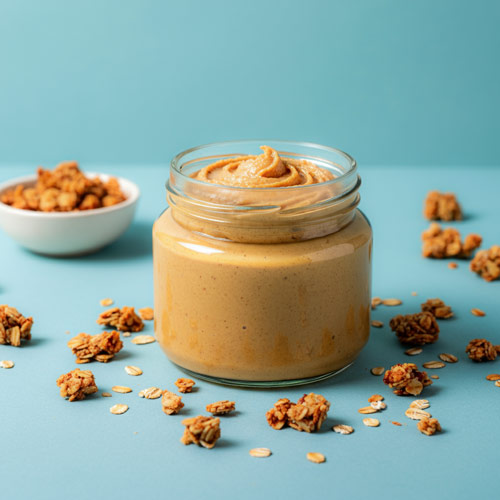
Have you tried granola butter yet? This rising star is gaining attention—and for good reason. Made with wholesome ingredients, it’s both delicious and incredibly versatile. If you run a cafe or even a fast food retail outlet, adding granola butter to your offerings could be the perfect way to elevate your dishes and make them truly stand out.
Want to know how it can elevate your offerings? Stick around for a quick granola butter recipe, sourcing tips, and creative ways to wow your customers with this moreish ingredient.
Why Granola Butter Belongs on Your Menu
1. A Nut-Free Champion for All
With allergies rising, offering a nut-free option isn’t just considerate—it’s good business. Granola butter is made with simple ingredients like oats, seeds, and oil, making it a safe and inclusive alternative to nut spreads.
Important note – please make sure your granola is nut-free if you want to promote this as a nut-free offering.
2. Wholesome and On-Trend
Shoppers and diners alike are more health-conscious than ever. Granola butter fits perfectly into this demand, offering a unique selling point that appeals to those seeking nutrient-packed, plant-based options.
3. Versatility That Surprises
Granola butter isn’t just a spread. It’s a multi-functional ingredient that can enhance everything from breakfast dishes to sweet desserts. Whether drizzled, melted, or dolloped, its rich, oat-y flavour adds warmth and depth to countless recipes.
If you’re looking to attract the Instagram crowd and deliver on taste, granola butter ticks all the boxes.
Simple Granola Butter Recipe
Why buy when you could make it fresh in-house? Below is a quick recipe to whip up a batch of velvety granola butter. Plus, by making it yourself, you’ll have complete control over the flavours as well as the quality.
Ingredients
- 2 cups Opera Foods Super Crunch Nut-Free Granola
- 2 tablespoons coconut oil (melted)
- 2 tablespoons maple syrup or honey
- 1 teaspoon vanilla extract
- 1/2 teaspoon cinnamon (optional)
- A pinch of sea salt
- 1/4 cup water (adjust for desired consistency)
Instructions
- Prepare the Granola
Begin by adding the Opera Foods Super Crunch Nut-Free Granola to a food processor or high-powered blender. Blend for about 1-2 minutes until the granola begins to break down into a coarse powder.
- Add Wet Ingredients
Slowly add the melted coconut oil, maple syrup or honey, vanilla extract, and cinnamon (if using) to the granola. Blend again until the mixture begins to clump together.
- Adjust Texture
Gradually add water, one tablespoon at a time, blending continuously. Continue until the mixture reaches your desired consistency.
- Season to Taste
Sprinkle a pinch of sea salt into the mixture and blend briefly to combine. Taste and adjust sweetness or seasoning as needed.
- Store and Enjoy
Transfer the granola butter to a clean glass jar or airtight container. Store in the refrigerator for up to two weeks. Bring to room temperature or stir before using if the mixture thickens over time.
Pro Tip: Offer small branded jars labelled with your cafe’s logo—customers love take-home options!
Creative Ways to Use Granola Butter on Your Menu
Once you’ve perfected your granola butter, the next step is integrating it into crowd-pleasing dishes. Here are some cafe-friendly ideas to inspire.
1. Smoothie Bowls That Shine
Layer a dollop of drippy granola butter onto vibrant smoothie bowls. It not only adds indulgence but creates an Instagram-ready swirl that your diners will love snapping.
2. Toast, But Elevated
Upgrade traditional avocado or peanut butter toast by spreading thick layers of granola butter. Top with fresh banana slices, a drizzle of honey, and a sprinkle of chia seeds for a textural masterpiece.
3. Granola Butter Pancakes
Warm the granola butter and serve it as a silky topping for your pancake stacks. Pair it with maple syrup and mixed berries for a health-forward twist.
4. Desserts, Reimagined
Granola butter is the perfect base for inventive treats. Try it in granola butter blondies, as a filling for tartlets, or swirled into banana bread. The possibilities are endless!
5. Beverage Add-On (Yes, It Works!)
Swirl a teaspoon into hot lattes or smoothies for a nut-free, creamy flavour burst. This subtle addition can elevate your drinks menu with minimal effort.
A Secret Weapon for Your Cafe Menu
Introducing granola butter to your cafe could be just the unique spin you have been looking for, and this on-trend ingredient can elevate even the simplest of dishes into something unforgettable.
Start exploring granola butter today, and who knows? Your creations might just become the next viral sensation in cafes across Australia!
Why not experiment with different granolas from our extensive range?
This article was reproduced on this site with permission from operafoods.com.au the “Wholesale Café Suppliers”.
See original article:- Elevate Your Menu with Granola Butter
Is Granola Good for Weight Loss?
Granola often finds itself in the spotlight as a go-to “healthy” snack or breakfast choice. It’s crunchy, full of flavour, and packed with ingredients that sound good for you, but does it live up to its weight-loss-friendly reputation?
If you’ve ever wondered whether granola is a help or a hurdle for weight loss, you’re not alone. The truth is, granola can be both, depending on what’s in it and how you use it.
What Is Granola?
Granola is a mixture of rolled oats, nuts, seeds, and dried fruit that is baked together, often with oils and natural sweeteners like honey or maple syrup. It’s delicious and comes in countless varieties. Some are simple and full of natural goodness, yet others are heavily loaded with chocolate, sugar, and high-calorie extras.
Nutritionally, granola can be a great choice, delivering fibre, protein, and healthy fats. But there’s a catch—it’s also calorie-dense. A small serving (as little as 1/4 cup) can easily pack 150–200 calories, depending on the brand and recipe. This makes choosing the right kind of granola—and eating it in moderation—critical, especially if you’re focusing on weight loss.
The Pros of Granola for Weight Loss
But granola can fit into a weight-loss plan, and here’s why.
1. High in Fibre
The oats, nuts, and seeds in granola are full of fibre. Fibre helps you feel full longer, reducing the likelihood of overeating or reaching for a snack an hour later.
2. Packed with Nutrients
Granola is often loaded with things your body loves, like vitamins, minerals, and healthy fats. For example, nuts and seeds provide essential nutrients such as magnesium and omega-3 fatty acids.
3. Versatility
Granola is incredibly easy to pair with low-calorie foods. A little sprinkled over Greek yoghurt and fresh berries? Delicious. Mixed with unsweetened almond milk? Quick and simple.
4. Energy on the Go
If you’re active, granola makes an excellent portable snack. The blend of carbs, fats, and protein provides sustained energy, making it particularly useful before or after workouts.
The Cons of Granola for Weight Loss
While granola has its perks, it’s no weight-loss miracle. Here are a few things to watch out for.
1. High-Calorie Density
Many granolas pack a ton of calories into a small portion. A heaping bowl can easily exceed 400 calories before you even add milk or toppings.
2. Hidden Sugars
Store-bought granolas often sneak in added sugars, which can undermine your weight-loss goals.
3. Hard-to-Control Portions
Granola feels like a “health food,” which makes it easy to overeat. But those extra handfuls you grab straight from the bag? They add up quickly.
4. Fat Content
While healthy fats are beneficial, they’re also calorie-dense. Nuts, seeds, and oils contribute to the richness of granola, but also to its caloric load. Balance is key.
How to Choose Weight-Loss-Friendly Granola
All granolas are not created equal. Here’s how you can identify the best options for your weight-loss goals.
Read the Labels
Look for granolas with fewer than 10 grams of sugar and around 150 calories per serving. Check the ingredient list—short and simple is best.
Focus on Whole Ingredients
Choose granolas where oats, nuts, and seeds take centre stage, rather than added sugars or fillers.
Avoid Sugary Extras
Skip granola with chocolate chips, candy, or anything that sounds like dessert. Natural is better.
Make Your Own
Homemade granola gives you full control over ingredients and portion sizes. Plus, it’s easier than you might think!
Our classic maple nut crunch is just the kind of granola you need to support your weight loss goals.
Tips for Incorporating Granola Into a Weight-Loss Diet
Granola is a delicious tool, but it requires a bit of strategy in a weight-loss plan. Here’s how to balance it right.
- Watch Portions: Stick to the serving size—typically 1/4 to 1/3 cup. Use a measuring scoop for accuracy.
- Pair It Smartly: Combine granola with low-calorie, nutrient-rich options. Add it to plain Greek yoghurt, almond milk, or as a topping for fresh fruit.
- Think of it as a Topping: Rather than making granola the star of your breakfast, use it as a sprinkle for added crunch and flavour.
- Use It at the Right Time: Granola can be a great pre- or post-workout snack, giving you energy when you need it most and helping to refuel your muscles.
Find out why skipping breakfast won’t help you manage your weight.
A final word
So yes, granola can be part of a weight-loss plan—but it’s all about making smart choices. Opt for low-sugar varieties, keep your portions in check, and pair with nutrient-dense, low-calorie foods. It’s important to remember that granola, like any food, isn’t inherently good or bad; it’s how you use it that matters.
Whether you’re sprinkling it on yoghurt or enjoying a sneaky snack, granola can satisfy your taste buds and fuel your goals when consumed mindfully.
Explore our full range of healthy cereals today. Read more about healthy cereals to enjoy on your weight loss journey.
This article was reproduced on this site with permission from operafoods.com.au the “Healthy Cereal Wholesalers”.
See original article:- Is Granola Good For Weight Loss?
Why Switch to Low Sugar Granola?
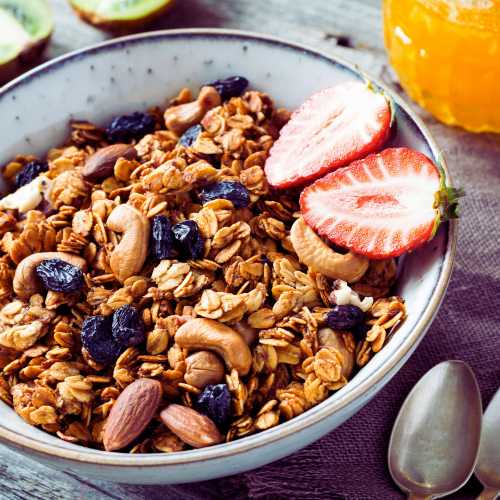
If you’ve been looking to make healthier food choices or level up your breakfast game, switching to low sugar granola could be just the start you need. Granola is a breakfast favourite, universally loved for its satisfying crunch and moreish sweetness. Whether sprinkled on your yoghurt or enjoyed with cold milk, it’s a morning go-to for many. But behind the wholesome facade, many granolas are loaded with hidden sugars that make them less healthy than they appear.
In this post, we explore the downsides of high sugar granola, the benefits of low sugar alternatives, and how to make this transition seamless and delicious.
Are you ready to swap your sugary breakfasts for low sugar granola?
The Problem with High Sugar Granola
At first glance, granola might seem like a health food, a mix of oats, seeds, and honey clustered together into a wholesome breakfast. However, many mainstream granola options, even those packaged as “healthy”, contain alarmingly high sugar levels.
The Impact of High Sugar on Health
Too much sugar in your diet can wreak havoc on your body in several ways.
Energy crashes
High sugar content leads to quick energy spikes followed by fatigue, making it tough to stay energised through your morning.
Weight gain
Excess sugar contributes to empty calories, making it harder to maintain or lose weight.
Chronic illnesses
Diets high in sugar can increase the risk of serious conditions like type 2 diabetes, heart disease, and even certain cancers.
Misleading Healthy Branding
Many granola packs labelled as “natural” or “organic” can still be high in added sugar. Terms like “sweetened with honey” sound better on the surface, but can also add up to just as much sugar as alternatives.
Benefits of Low Sugar Granola
Making the switch to low sugar granola is about more than just cutting back on sweetness. It’s about creating a healthier, more balanced start to your day.
Stable Energy Levels
Low sugar granola fuels you with slow-releasing carbohydrates, providing long-lasting energy without the midday slump. You’ll feel steady and clear-headed, whether at work, in the gym, or managing your busy household.
Supports Weight Management
Granolas with less sugar are usually higher in fibre and protein. These two ingredients help keep you fuller for longer, reducing the temptation for mid-morning snacks.
Reduces Risk of Chronic Diseases
Lowering your sugar intake with a breakfast option like low sugar granola can significantly reduce the long-term health risks associated with high-sugar diets, such as diabetes and high cholesterol.
Better for Digestion
Low sugar granolas often include natural ingredients like whole grains, nuts, and seeds, making them a great source of fibre. Fibre supports a happy gut by improving digestion and keeping everything moving comfortably. It is also a valuable prebiotic that supports a healthy gut microbiome.
Read more about the benefits of high fibre cereal.
What to Look for in Low Sugar Granola
Not all granolas are created equal, even among low sugar options. Here’s a quick checklist of what to look for when shopping for your new breakfast go-to.
Ideal Sugar Content
Keep an eye on the sugar per serving. More about this later, as it isn’t as clear-cut as it may seem.
Natural Sweeteners
Choose granolas that rely on small amounts of natural sweeteners like honey, dates, or dried fruits instead of refined sugars or syrups.
Wholesome Ingredients
Look for whole grains like oats, heart-healthy nuts like almonds, and nutrient-rich seeds like chia or flax. Avoid options with artificial flavours or unnecessary additives. Natural is best for keeping your body happy!
Making The Transition To Low Sugar
When you make the transition to a low sugar lifestyle, the first thing you might notice is a distinct lack of options on the supermarket shelves. Gluten-free, vegan, and even dairy-free options seem to take up more and more shelf space, but sugar-free? It is just not a thing.
On the one hand, this is disappointing, as who doesn’t want some no-sugar chocolate from time to time? Yet, what this does is automatically take a million processed options off the table, pushing you towards a diet of natural produce. Which can’t be all bad, right?
How to Cut Down on Sugar in Your Diet
You could go completely cold turkey and eliminate all sources of added sugar from your shopping list. For many, this is the easiest way to go as it can eventually curb all cravings. You could then either stay that way (which, trust us, is super hard) or reintroduce lower sugar options gradually.
Or, you could simply cut out many sources of unnecessary sugar from your diet. Healthy eating guidelines suggest that sugar makes up no more than 10% of our daily calories.
Understanding Hidden Sugars
Hidden sugars can sneak into our diets through everyday foods we might not suspect. Items like bread, pasta sauce, salad dressings, and even seemingly healthy snacks such as granola bars often contain added sugars. It’s important to be mindful of these hidden sources, as they can quickly add up and exceed recommended daily limits.
Reading food labels is one of the best ways to identify added sugars in your diet. Look for the “added sugars” section on the nutrition facts label, which lists how much sugar was added during processing. Additionally, check the ingredients list for any sweeteners, as they might not always be obvious.
Sugar often hides behind different names, so learning its pseudonyms can be incredibly helpful. Words like sucrose, high-fructose corn syrup, dextrose, maltose, and even natural-sounding options like honey or agave nectar are all forms of sugar. Being aware of these alternate terms makes it easier to spot and reduce unnecessary sugar intake.
Making Smart Food Swaps
One way to reduce sugar intake is by replacing sugary snacks with healthier alternatives. Instead of reaching for cookies, candies, or other processed sweets, try opting for fresh fruit, nuts, or plain yoghurt. These options not only satisfy hunger but also provide essential nutrients without added sugars.
Another effective strategy is substituting sweetened drinks with water, herbal teas, or sugar-free options. Sugary beverages like sodas, flavoured coffees, and energy drinks can significantly increase daily sugar consumption. Replacing them with zero-sugar alternatives or adding a slice of lemon or cucumber to water can make a refreshing and healthier choice.
Finally, you can satisfy your sweet tooth naturally by using ingredients like fresh fruits, unsweetened applesauce, or spices like cinnamon to enhance sweetness in your meals and snacks. These options give natural sweetness while avoiding the spike in blood sugar caused by refined sugars, creating a balance between indulgence and health.
Cooking and Baking at Home
Cooking and baking at home are the best way to take control of the ingredients you use, particularly when it comes to sugar. By preparing homemade meals, you can monitor the amount of added sugar and choose healthier alternatives that suit your dietary preferences.
Exploring sugar-free or low-sugar recipes is easier than you might think. From wholesome desserts like banana oat cookies to savoury dishes with naturally sweet ingredients like roasted vegetables, there are countless options to enjoy delicious flavours without relying on refined sugars. The focus is on whole, nutrient-dense ingredients, enabling you to indulge while nourishing your body.
Natural sweeteners such as honey, dates, or stevia can be excellent substitutes for processed sugar in your cooking and baking. Honey offers a rich, distinctive taste and beneficial antioxidants, while dates provide natural sweetness alongside a boost of fibre. Stevia is a plant-based option that delivers sweetness without impacting blood sugar levels, making these alternatives a win-win for flavour and health.
Managing Cravings and Building Habits
Understanding why sugar cravings happen can be the first step toward managing them effectively. Cravings often stem from a mix of physiological and emotional factors, such as drops in blood sugar, stress, or even habits formed over time. Recognising these triggers makes it easier to address them in a way that suits your lifestyle.
To reduce and overcome sugar cravings, it’s important to adopt practical strategies. Incorporating more protein and fibre into your meals helps maintain steady energy levels, while staying hydrated and getting enough sleep can prevent cravings caused by fatigue or dehydration. Finding healthier alternatives, like fruit or naturally sweetened options, can also satisfy your sweet tooth without derailing your goals.
Building long-term habits for a lower sugar diet involves gradual, consistent changes. Start by reducing sugar intake in small steps, such as switching to unsweetened drinks or reading food labels to avoid hidden sugars. Over time, your taste buds will adjust, making it easier to enjoy foods with less sweetness. By focusing on balance and moderation, these habits can set the foundation for a healthier, more sustainable lifestyle.
How Much Sugar is Low Sugar?
Choosing low sugar products is not always as straightforward as it may seem, and as usual, finding a balance is key.
Australian guidelines suggest that we should keep sugar to a minimum of 10% of our daily intake. Which sounds fair, and more importantly, doable. They also suggest, presumably to take into account free sugars found in natural produce (the stuff with no label attached) to qualify as officially ‘low-sugar’, packaged foods (anything with a label) should contain less than 5% sugar. So far, so good.
Yet there are a few things to consider here.
One is what replaces that sugar in ‘low-sugar’ products. These are often packed with artificial sweeteners or are otherwise of very little nutritional value.
Two is a a simple question of relativity. If you consider the fact that something like a sugary breakfast cereal (or even a ‘healthy’ granola) can contain as much as 40% sugar, then cutting that down to 10% is a huge reduction in itself.
The point here, and something that food manufacturers and even governments tend to downplay or overlook, is that food quality is important. Empty calories benefit no one in the long run.
Opera Foods Low Sugar Granola
We have always aimed to create our award-winning healthy cereals with lower sugar than mainstream cereal brands. Most, if not all, contain less than 10% sugar and are made with natural ingredients and healthy alternatives in mind.
Our original, classic, acai bowl granola contains less than 10g of sugar per 100g. And that’s ‘proper’ granola, made with oats and sugar.
The Long-Term Impact of Choosing Lower Sugar Options
A single swap, like moving to low sugar granola, can lead to broader changes in your overall diet.
Healthier Eating Habits
Opting for lower sugar granola can inspire other mindful swaps in your day-to-day meals.
Improved Energy and Focus
A more balanced breakfast can help you feel more productive and present, both in your work and personal life.
Find out more about what makes a balanced breakfast.
Reduced Health Risks
Over time, lowering your sugar intake can improve your heart health, mental clarity, and overall resilience against chronic illnesses.
A Healthier Breakfast Choice
Starting your day with low sugar granola isn’t just about cutting sugar. It’s about making your mornings feel indulgent while valuing your health. Breakfast is the foundation of your day, and you deserve one that fuels you properly.
Want to start creating better breakfasts? Explore our range of low sugar granola options to find your perfect match. Start your day the healthy way!
This article was reproduced on this site with permission from operafoods.com.au the “Healthy Cereal Wholesalers”.
See original article:- Why Switch to Low Sugar Granola?
Low Carb Granola vs Traditional Granola – What’s the Difference?
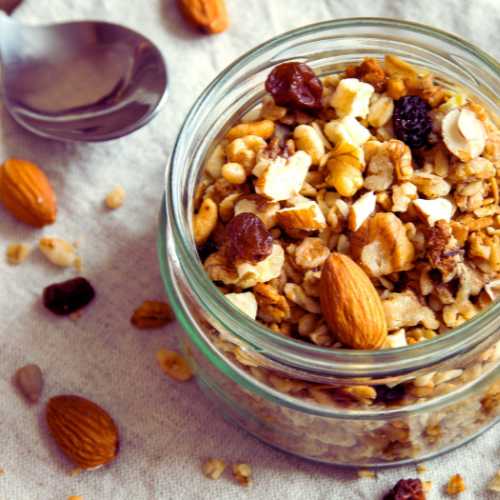
Breakfast might be the most important meal of the day, but if you’re following a keto or low-carb lifestyle, finding the right cereal or granola can feel like navigating a maze. Traditional granola might be a long-standing classic, but low-carb granola is rising in popularity as a breakfast and snack option designed to fit specific dietary needs. But what exactly sets these two apart? And how do you choose the one that’s right for you?
This post looks at the key differences between traditional and low-carb granola. If you’ve been wondering whether you can enjoy a bowl of cold, crunchy cereal on a keto or low-carb diet, you’ll find all the answers here.
What Is Traditional Granola?
Traditional granola is a breakfast favourite, typically made from whole rolled oats combined with dried fruits, nuts, seeds, and sweeteners like honey or maple syrup. Some recipes also include additional ingredients like coconut, chocolate chips, or added oils to enhance flavour and texture.
On average, a single serving of traditional granola (around 1/2 cup or 50g) contains:
- Calories: 200–300 kcal
- Carbohydrates: 40–50g (including added sugar)
- Protein: 5–7g
- Fat: 6–8g
- Fibre: 3–5g
While it offers fibre, protein, and healthy fats (particularly from the nuts and seeds), the high carbohydrate content makes it less suitable for low-carb or keto diets. For those who aren’t concerned about carb intake, traditional granola can provide an energy boost and serve as a filling option when paired with milk, yoghurt, or fruit.
Find out why granola, fruit and yogurt may just be the ideal breakfast combination.
Benefits of Traditional Granola
For many, the appeal of traditional granola lies in its simplicity. And of course, that moreish combination of sweetness and crunch. Yet it does have other benefits too.
Rich in Fibre
Packed with oats, dried fruits, and nuts, traditional granola is surprisingly full of fibre. In particular, the soluble fibre in oats can help support healthy digestion and may aid in reducing cholesterol levels.
Energy Booster
Thanks to its carbohydrate load, traditional granola is an instant energy booster, making it excellent for athletes or those with demanding mornings.
Convenient and Customisable
Traditional granola is the ultimate straight out the pack cupboard snack. Because who needs a bowl, right?
It is also highly customisable, so you can add mix-ins like raisins, coconut flakes, or dark chocolate for endless variety and taste.
Take note though however, as the high sugar content in many commercial brands can lead to energy crashes later in the day, making portion control essential.
What Is Low Carb Granola?
Low-carb (or keto-friendly) granola has been crafted to cater to those following low-carb, ketogenic, or even high-protein diets. Unlike traditional granola, it swaps out oats and other carb-heavy grains for ingredients like almond flour, crushed nuts, coconut flakes, and seeds such as chia, linseed, or pumpkin. Sweeteners like stevia or erythritol may be used instead of honey or sugar.
A 50g serving of low-carb granola typically provides:
- Calories: 200–280 kcal
- Carbohydrates: 5–15g (net carbs, subtracting fibre and sugar alcohols)
- Protein: 10–12g
- Fat: 15–20g
- Fibre: 4–7g
This ensures an ultra-low carb count while still delivering the satisfying crunch you’d expect from granola.
Want to know more about how many carbs will keep you in ketosis?
Benefits of Low Carb Granola
Low-carb granola offers its own set of unique perks.
Maintains Stable Blood Sugar Levels
The reduced sugar content in keto granola helps prevent energy crashes and keeps blood sugar in check.
Keto-Friendly
Keto cereal is specifically designed to fit neatly within daily keto macros, helping you to stay in ketosis.
Supports Weight Management
Many people are now experiencing the weight management benefits of either a low-carb or a full-blown keto diet. Alongside its reduced carb content, keto granola can also help with weight loss by providing sustained satiety, thanks to its higher protein and fat content.
Customisable for Dietary Preferences
Keto cereal is often gluten-free, vegan, and suitable for individuals with food sensitivities or allergies. Our keto granola is gluten-free and vegan, as well as low in carbs.
For Australians navigating their keto or low-carb diet plan, choosing low-carb granola simplifies breakfast without sacrificing the joy of a crunchy cereal bowl.
Comparing Traditional and Low Carb Granola
When deciding between traditional granola and its low-carb counterpart, a few factors set the two apart.
1. Ingredients
Traditional granola prioritises oats, honey, and dried fruits.
Low carb granola swaps these for nuts, seeds, and low-carb sweeteners.
2. Taste and Texture
Traditional granola is known for its sweet taste and crunchy clusters.
Low carb granola has a more natural flavour and is likely to feature sweet spices such as vanilla or cinnamon. The texture can range from the familiar crunchy clusters (almond flour is good for this) to something more like toasted muesli.
3. Satiety and Fullness
Low-carb granola, with its focus on protein and fat, can keep you fuller for longer than carb-heavy traditional granola.
4. Suitability
Traditional granola suits high-energy eaters. It is important to remember that low carb is not for everyone, and some people simply suit a higher carb intake.
Low carb granola is ideal for keto dieters and those watching their carb intake. Proof that the pleasures of cereal for breakfast are still very much on the table.
How to Choose the Right Granola for You
Choosing the right granola involves aligning your dietary preferences, lifestyle, and health goals. Follow these tips.
Read Labels Carefully
Watch for hidden sugars, unhealthy oils, or preservatives in traditional granolas. For low-carb options, confirm the net carb content.
Consider Your Goals
For sustained energy during workouts, traditional granola works. For weight management or low-carb diets, try keto granola.
Focus on Quality Ingredients
Whether you’re looking at oats or almonds, prioritise wholesome, minimally processed ingredients (like we do).
Strike a Balance
Not sure what works? Alternate between the two based on your daily nutritional needs. Some days are just different from others, and learning to listen to your body is just as important as sticking to guidelines.
Both traditional granola and low-carb granola deserve their place in your breakfast bowl, depending on what you’re after. While traditional granola delivers on energy and classic taste, low-carb granola excels in keeping carbs down and supporting specific dietary goals. For low-carb dieters, the good news is that you can absolutely enjoy cereal as a breakfast or snack option.
Looking to effortlessly upgrade your mornings? Try our keto-friendly granola and experience the perfect blend of crunch, flavour, and focused nutrition.
This article was reproduced on this site with permission from operafoods.com.au the “Healthy Granola Wholesalers”.
See original article:- Low Carb Granola vs Traditional Granola – What’s the Difference?
Common Foods to Avoid on Keto (and What to Eat Instead)
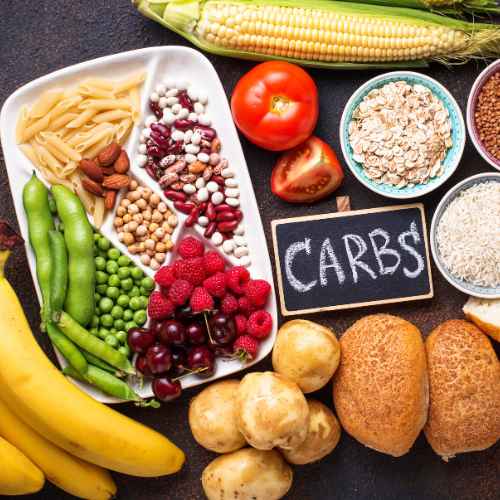
If you’re embarking on the ketogenic diet (or just considering it), you probably know that it’s all about keeping carbs low and fats high. But did you know that some seemingly “healthy” foods could secretly derail your progress? With so much conflicting advice, it’s crucial to know exactly which foods to avoid on keto—and what to eat instead—to stay on track.
Here’s a guide to help you avoid the most common keto pitfalls and stay on a path toward low-carb success.
What Is the Keto Diet All About?
At its core, the keto diet focuses on limiting carbohydrates while significantly increasing fat intake. By doing so, your body enters ketosis, which burns fat for energy instead of carbs. This metabolic switch can lead to weight loss, improved energy, and other health benefits.
But reaching (and staying in) ketosis isn’t always simple. Many foods—some obvious, some surprising—are packed with carbs that could kick you out of this fat-burning state. Below, we’ll break down the most common food culprits and offer delicious, keto-friendly alternatives to keep your meals satisfying and on plan.
Foods to Avoid on Keto
Sugary Foods and Drinks
We’re starting with the biggest no-brainer—sugar is a keto diet’s arch-nemesis. Candies, cakes, cookies, sodas, and even many “natural” sweeteners (like honey or agave) are loaded with sugars that can spike insulin levels and prevent your body from maintaining ketosis.
Examples of sugary foods to avoid
- Sodas and sugary drinks
- Ice cream, cakes, cookies
- Pre-packaged sweets and chocolates
Why are sugary foods off-limits?
Just one can of soda can contain upwards of 40g of carbs, which is more than double the daily carb limit for most keto dieters. These carbs add up in seconds, pulling your body out of ketosis.
What to reach for instead of sugary foods
When you’re craving something sweet, seize keto-friendly alternatives like stevia or monk fruit as natural sweeteners. Indulge in recipes for homemade keto desserts (think chocolate mousse sweetened with erythritol or keto-friendly cheesecake).
Grains and Starches
This might be hard to hear, but bread, pasta, rice, and other starchy staples are off-limits on keto. These foods are loaded with carbs and lack the healthy fats your body craves on this diet.
Examples of grains and starches to avoid
- White and wholegrain bread
- Pasta (including “whole wheat” pasta)
- Rice, oats, quinoa, and similar grains
Why are grains and starches off-limits?
Grains, even when labelled as “whole”, are dense in carbohydrates. For instance, a cup of cooked rice contains around 45g of carbs—enough to knock you out of ketosis entirely.
What to eat instead of grains and starches
Luckily, there are clever swaps! Spiralized zucchini or shirataki noodles can stand in for pasta, and cauliflower rice is a fantastic keto substitute for traditional rice. You won’t even notice the difference once paired with sauces or seasonings!
High-Carb Fruits
Yes, fruit is natural. But natural doesn’t equal low-carb. Many fruits are surprisingly high in sugars, which can spike your carb intake quickly.
Examples of fruits to avoid
- Bananas
- Apples
- Grapes
Why are some fruits off-limits?
A single banana can contain over 25g of carbs, making it more of a sugar bomb than a healthy snack on keto.
What to eat instead of high-carb fruits
Stick to low-carb fruits like berries (strawberries, blackberries, raspberries). These pack a punch of antioxidants with minimal carbs—perfect for sweet cravings.
Legumes
Legumes might be a go-to for plant-based dieters, but they’re pretty much a no-go for anyone following keto.
Examples to avoid
- Beans (black beans, chickpeas, kidney beans)
- Lentils
- Peas
Why are they off-limits?
Legumes are high in both carbs and fibre. A single cup of black beans has around 40g of net carbs, making it incompatible with the ketogenic diet.
What to eat instead
If you’re looking for plant-based protein, opt for tofu, tempeh, or keto-friendly nuts like walnuts or pecans.
Processed Foods
Pre-packaged meals, crisps, granola bars, and certain condiments often contain hidden sugars, unhealthy oils, and additives that can mess with ketosis.
Examples of processed foods to avoid
- Crisps and crackers
- Pre-made frozen meals
- Grain-based breakfast cereals
Why are many processed foods off-limits?
Packaged foods often hide carbs in the form of sugar or additives. These hidden carbs can disrupt ketosis while offering little nutritional value.
What to eat instead of processed, packaged foods
Opt for whole, unprocessed foods. Snacks like pork rinds, unsweetened nut butters, or hard cheeses are great keto-friendly options to satisfy cravings.
Even the most innocent-sounding breakfast cereal can knock you out of ketosis. Look for keto-friendly cereals made from nuts and seeds instead.
What to Eat on a Ketogenic Diet
Now that we’ve tackled the no-go list, here’s what your keto-friendly kitchen should stock instead.
Low-Carb Vegetables
Load your plate with non-starchy vegetables. These are full of fibre, vitamins, and antioxidants, keeping your meals nutrient-packed and low-carb.
Examples of low-carb vegetables include broccoli, spinach, cauliflower, and zucchini.
These veggies make great sides, bases for keto pizza crusts, or even rice substitutes.
Protein Sources
Protein keeps you full and fuels your body—an essential component of a keto plan. Whether you’re a meat-eater or plant-based, there are plenty of options.
Examples of protein sources include eggs, chicken, beef, pork, fish such as salmon or mackerel, and plant-based options like tofu and tempeh.
Aim for high-quality sources like grass-fed meat or wild-caught fish to maximise nutritional benefits.
Healthy Fats
Fat should take centre stage in your keto diet. Beyond being a major energy source, healthy fats keep you full and enhance food’s flavour.
Examples of healthy fats to include in your keto diet are avocado and avocado oil, olive oil, nuts like almonds and macadamias, as well as butter and ghee.
Add fats generously to your cooking for satisfying, keto-friendly meals.
Keto-Friendly Snacks
Snacking on keto doesn’t have to be boring! Choose options that align with your diet while curbing cravings.
Choose delicious options like cheese (cheddar, mozzarella, brie), pork rinds, dark chocolate with 85% cacao or higher, and homemade keto fat bombs.
A handful of our blueberry keto granola will keep those hunger pangs at bay, so don’t forget to carry some with you.
These options are not just filling but also easy to pack for on-the-go snacking.
Tips for Staying on Track
To succeed on keto, it’s all about preparation and awareness. Here are some essentials to keep in mind.
Read Food Labels
Hidden carbs can lurk in sauces, dressings, and condiments. Check nutrition labels for sugars and net carbs.
Meal Prepping
Pre-cook several keto meals for the week to avoid last-minute decisions that might derail your progress.
Find Substitutes
Craving bread? Try keto-friendly bread made with almond flour. Missing sweets? Use sugar-free alternatives like stevia or erythritol.
With these strategies, staying in ketosis becomes a breeze.
The Final Word
Our best advice? Keep it simple and delicious. The keto diet doesn’t have to feel restrictive! Knowing which foods to avoid and what to eat instead is the key to creating meals that are not only low-carb but also satisfying and nutrient-dense.
Start small by swapping out high-carb staples with creative, low-carb alternatives such as our keto granola. And remember, consistency over time leads to the best results.
This article was reproduced on this site with permission from operafoods.com.au the “Keto Granola Supplier”.
See original article:- Common Foods to Avoid on Keto (and What to Eat Instead)
How Many Carbs On Keto? A Practical Guide.
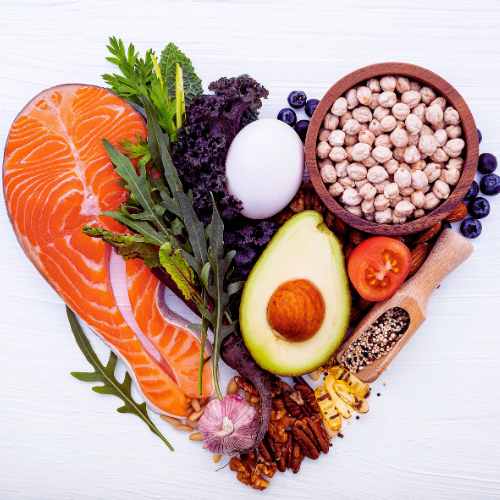
When starting the keto diet, there’s one golden question everyone asks. How many carbs can I eat and still stay in ketosis? If you’ve toyed with the idea of going keto or are already partway through your low-carb adventure, understanding carb intake is essential to your success.
This guide will break down everything you need to know about carbs on the ketogenic diet, from how carbs affect your body to practical tips for staying in that coveted state of ketosis. You’ll learn exactly how many carbs on keto are right for you and how to simplify your food choices to help you stay on track.
What Is The Keto Diet?
The ketogenic diet, or keto for short, is a low-carb, high-fat diet aimed at shifting your body’s primary energy source from carbohydrates to fat. This state is called ketosis and is the hallmark of keto success.
What is Ketosis?
Ketosis is a metabolic state where your body uses fat as its primary energy source instead of carbohydrates. This happens when you significantly reduce your carbohydrate intake, lowering blood glucose levels and depleting glycogen stores. Without enough glucose for energy, your liver starts breaking down fats into molecules called ketones, which can be used by your brain, muscles, and other tissues as fuel.
Why does this matter?
Carbs are your body’s default energy source. By slashing carb intake, you force your system to adapt, burning fat stores more efficiently. For many, this means weight loss, reduced inflammation, and increased energy, among other benefits.
However, there’s one catch—carbs must be tightly controlled. If you eat too many, you can drop out of ketosis entirely. But how many carbs are “too many”? Let’s explore the numbers.
How Many Carbs Per Day on Keto?
The standard ketogenic diet ratios are 70% fat, 20% protein, and 10% carbs. This means that 70 percent of your daily calorie intake should come from fat, 20 percent from protein, and just 10 percent from carbohydrates.
The general rule of thumb is to limit your carb intake to 20–50 grams of net carbs per day.
Understanding Net Carbs
You may have noticed the emphasis on net carbs. This is because not all carbs are created equal. “Net carbs” refer to total carbohydrates minus dietary fibre (and sometimes sugar alcohols, depending on the context). Fibre doesn’t spike insulin or blood sugar, so it doesn’t typically interfere with ketosis.
For example, one cup of raw spinach contains about 3.6 grams of total carbs, but 2.2 grams are fibre. That leaves you with just 1.4 grams of net carbs.
A 60g portion of rice, on the other hand, contains about 53 grams of total carbs but only 2 grams of fibre. That’s 51 grams of net carbs! Visually, once cooked, this looks like roughly a cup of rice.
So when calculating grams of carbs on keto, make sure to focus on net carbs (not total) and choose high-fibre options whenever possible.
Navigating The Carb Conundrum
But counting grams of carbs is not the only way to figure out your carbohydrate intake. It is the method officially associated with the keto diet and may offer just the precision you need, but other strategies can also help you manage your carbohydrate intake effectively.
Going from high-carb directly to keto can be a pretty rough transition, and it can be helpful to first get a grasp of where on that carbohydrate spectrum you sit. Some people can jump from a high-carb diet directly into keto without any problem, but for others, it may be more helpful to gradually decrease their carb intake over time. This can make the transition easier and help prevent some of the common symptoms experienced when adapting to a low-carb or ketogenic diet.
Understanding how carbohydrates work in the body and learning how to effectively manage your carb intake is key to success on the keto diet. The next section aims to bridge that gap.
The Glycemic Index and The Glycemic Load
The glycemic index and its cousin, glycemic load, are helpful tools for understanding how different foods impact blood sugar levels, making it easier to manage your intake effectively. Developed for the management of blood sugar levels, it is, however, a useful guide for those following the keto diet, particularly if you are new to controlling your carb intake.
The Glycemic Index (GI)
The glycemic index (GI) is a numerical scale that measures how quickly a carbohydrate-containing food raises blood sugar levels after consumption.
Foods are ranked on a scale from 0 to 100, with higher values indicating that the food causes a more rapid increase in blood glucose. Low-GI foods, which rank at 55 or below, are digested and absorbed more slowly, leading to more stable blood sugar levels.
Why does this matter?
For those following the keto diet, understanding the glycemic index helps manage carbohydrate intake more effectively. Remember, the keto diet relies on maintaining a state of ketosis, where the body burns fat for energy instead of carbohydrates.
Consuming high-GI foods can cause a spike in blood sugar and insulin levels, which may disrupt ketosis and hinder your progress. Low-GI foods, on the other hand, have a minimal impact on blood sugar, making them a better choice for staying in ketosis and supporting steady energy levels throughout the day.
OK, so what’s glycemic load?
The Glycemic Load (GL)
Glycemic load (GL) is a measure that takes into account both the glycemic index (GI) of a food and the amount of carbohydrates it contains in a typical serving. While the GI tells you how quickly a carbohydrate food is likely to raise your blood sugar levels, the GL gives a more complete picture by considering portion size alongside the carbohydrate’s impact.
This makes glycemic load a more practical tool for understanding how a particular food might affect your blood sugar in real-world eating scenarios. Foods with a low glycemic load are generally better for maintaining steady energy levels and managing blood sugar, which is especially important for those following a keto diet or looking to avoid blood sugar spikes.
Comparing Net Carbs with GI and GL
So, where does that leave our net carbs scenario? Do I need to count grams of carbs or not?
Net carbs, glycemic index (GI), and glycemic load (GL) all relate to how carbohydrates in foods impact your body, but they approach the topic from slightly different angles.
Let’s recap.
Net carbs focus on the amount of carbohydrates in a food that actually affect blood sugar. This excludes fibre and sugar alcohols, as they are either partially or completely undigested and have a minimal effect on blood glucose levels.
GI, on the other hand, measures how fast a carbohydrate-containing food raises blood sugar on a scale from 0 to 100, with higher values indicating a quicker spike.
GL builds on GI by factoring in the quantity of carbohydrates in a standard serving size of the food, providing a more comprehensive picture of its real-world impact on blood sugar.
When it comes to reaching and maintaining ketosis, it is net carbs that can make all the difference by giving you the precision you need to balance this delicate metabolic state.
But the glycemic index and, more importantly, the glycemic load, can give you a framework on which to build your food choices.
Using GL in the Keto Diet
So, we have ditched GI in favour of GL, as it allows us to think in terms of portion size. When you are controlling your food intake, especially for weight loss, knowing what a portion of food looks like on the plate is crucial.
Let’s get back to our concept of a food choices framework.
When you begin any diet, the major concern is to keep things simple. Assessing the current state of your food intake is probably a good place to start. Understanding that you are most likely going to have to make some major changes will aid your transition no end. Trying to crunch the numbers so that you can keep eating bread probably won’t.
It goes without saying that keto, low-carb, or any other healthy diet is most beneficial (not to mention easier to follow) when based around minimally processed whole foods. That’s a whole lot fewer labels you will have to read for a start!
The GL scoring system
Here’s how it works. GL is calculated by multiplying the glycemic index of a food by the amount of carbohydrates (in grams) it contains per serving, then dividing that number by 100.
A lower GL (10 or less) indicates a smaller effect on blood sugar, while a higher GL (20 or more) suggests a greater impact.
By focusing on foods with a low or moderate GL and avoiding those with a high GL, you are off to a good start in not just understanding your carbohydrate intake but also how to bring it under control. And, because it is directly associated with portion sizes, you have an easy-to-estimate guide of what (and how much of it) you need to be eating.
It is worth noting that you don’t have to do these calculations for yourself. Most foods, processed or otherwise, now have a GL score available.
Getting Started With The Keto Diet
Building a list of foods you can eat makes everyday eating far easier. Net carbs aside, let’s revisit those macro ratios and translate them into real life. Bear with us whilst we work through an example to get to some actual practical advice.
If the average woman needs 2000 kcals per day, and the average man needs 2500 kcals per day, then a 70/20/10 split would look like this…
2000 kcals per day breaks down into 50g carbs, 100g protein, and 155g fat.
2500 kcals per day breaks down into 62g carbs, 125g protein, and 195g fat.
Taking into account that there is no such thing as an average person and that weight loss generally involves a reduction of calories, these are pretty much maximum estimates.
Let’s look at those in real terms.
Carbohydrate
30g per day is a more realistic AVERAGE goal for ketosis. In terms of GL scores, that equates to 15 GL per day. Which is actually 10 to 15 portions of non-starchy vegetables per day.
Protein
The recommended amount (keto or not) is, on AVERAGE, 45g per day. If we consider 15g to be a portion, then we need 3 portions per day.
Fat
Which leaves the rest as fat. If we consider that one tablespoon of oil contains roughly 150 kcals and call that a portion, then based on the AVERAGE estimates for a woman, we would need 9 portions each day.
This might all sound overly complicated, but what could be simpler than counting portions per day?
But what’s in a portion?
A portion of carbs
It makes sense that the higher the glycemic load of a food, the smaller the portion should be. So for 1 GL, you could have a handful of broccoli or half a cucumber or a large handful of spinach or lettuce. You could also have a whole avocado, which incidentally counts as two of your fat portions, too.
Going up the scale, for 2 GL, you could have one medium tomato or half an onion. A small carrot comes in at 3 GL. Theoretically, foods with a score of lower than 10 GL are considered low on the scale, but you won’t get many of those in and remain in ketosis. One small banana, for example, will cost you 10 GL.
Out of interest, 3 small new potatoes come in at 16 GL, or you could have a handful of fries for 22 GL. One-third of a corn cob is 14 GL.
Filling half of your plate with veggies at each meal is clearly the only way to go.
A portion of protein
A portion of protein is generally considered to be a handful or a pack of playing cards. It is much simpler than working out carbs.
1 small chicken thigh with skin (50g), a small steak (100g), or a small fillet of salmon (55g) are all one portion of protein. As are two eggs, a handful of nuts (100g), or a wedge of Brie (75g).
Three of those a day, and you are done. It’s surprisingly little.
A portion of fat
Some foods get counted as fat, too. Like our avocado above, for example. But when you are aiming for a high fat ratio, trust us when we say this is a blessing, not a curse.
Protein foods often double up as fat portions. 2 chicken thighs are one portion of fat, whilst a rib eye steak is slightly more at one and a half. As we saw before, 1 tablespoon oil (be it olive, coconut, or whatever) is also one portion; two eggs are one portion, as is your wedge of Brie or handful of nuts and seeds.
Exploring keto? Read more in our article ‘Getting started with the keto diet. ‘
Keto-Friendly Foods Low in Carbs
Here’s a quick guide to some excellent keto-approved options.
Low-Carb Vegetables
These veggies are nutrient-packed and low in carbs, making them perfect for keto.
- Leafy Greens like spinach, kale, and arugula
- Cruciferous Vegetables, including broccoli and cauliflower
- Zucchini and other summer squashes
- Asparagus and bell peppers
- Mushrooms for their versatility and umami flavour
Keto-Friendly Proteins
Focus on high-quality protein sources that are rich in healthy fats.
- Fatty Fish such as salmon, mackerel, and sardines
- Poultry like chicken thighs with skin or duck
- Grass-Fed Meat, including beef, lamb, or pork
- Eggs, which are incredibly versatile and nutrient-dense
Healthy Fats
These fats are essential to maintaining energy levels and satiety.
- Avocados and avocado oil
- Olive oil and olives
- Coconut oil or MCT oil
- Nuts and Seeds like macadamias, almonds, chia seeds, and flaxseeds
- Butter and ghee, preferably grass-fed
Check out our article ‘The Keto Food List Explained’ for a more in-depth look at keto-approved foods.
Adjusting Your Carb Intake Over Time
We have looked at some ways to make life simpler when starting a keto diet by paying attention to glycemic load and getting familiar with portion sizes. Even just these simple measures will see you well on your way to a healthier diet and all the benefits it can bring.
Yet that does not necessarily mean you will be in, or stay in, ketosis. It might, but the key to any diet is understanding your own needs and tweaking the process according to what works best for you. And that’s where the fine-tuning and the precision of counting net carbs come in.
Finding Your Carb Tolerance
Identifying your personal carb limit to maintain ketosis is a crucial step in mastering this dietary approach. Everyone’s metabolism and lifestyle are unique, so the amount of carbohydrates you can consume while staying in ketosis might differ from someone else’s.
To figure this out, start by monitoring your daily carb intake and tracking your body’s responses, such as checking your ketone levels using urine strips or a blood ketone meter. Most individuals find their limit falls between 20-50 grams of net carbs per day, but it’s important to experiment and adjust based on your specific goals, activity level, and how your body reacts.
By finding your sweet spot, you’ll be better equipped to maintain ketosis and enjoy its benefits while still having flexibility in your diet.
Determining your ideal carb intake is often a process of trial and error, and that’s completely normal. Start by setting a baseline carb goal within the recommended range, such as 30 grams of net carbs per day. Stick to this amount for at least a week while keeping track of your ketone levels, energy, mood, and overall well-being. If you’re not achieving ketosis or feel sluggish, try lowering your intake slightly and observe any changes over the next few days.
On the other hand, if you’re consistently in ketosis and want to experiment with more flexibility, gradually increase your carb intake in small increments, such as 5 grams at a time, while continuing to monitor your body’s response.
Remember, everyone’s metabolism is unique, so patience and careful adjustments will help you find the balance that works best for you.
Signs You Might Need to Adjust
Too many carbs?
Obviously, one of the most noticeable signs that you’re consuming too many carbs on keto is being kicked out of ketosis. This can be identified by an increase in your blood sugar levels, which can be measured using a blood glucose or ketone meter.
Yet, there are other signals to look out for. These might include carb cravings, sudden energy crashes, or a return of brain fog and sluggishness. You might also notice bloating or other digestive discomforts as your body reacts to the extra carbohydrates.
If weight loss is part of your goal on keto, stalled progress or unexpected weight gain can also signal that your carb intake may be too high. Pay close attention to your body’s cues, and don’t hesitate to make adjustments to your diet as needed to stay on track.
Too few carbs?
Of course, this can go the other way as well.
When your carb intake is too restrictive, your body will often send clear signals that it’s not getting enough. Common signs include persistent fatigue, difficulty focusing, and feeling unusually irritable or moody. You might also experience headaches or dizziness, as your brain relies on a small amount of glucose to function optimally, even while on keto. Finding it hard to sleep can be an issue, often resolved with a slight increase in carb intake.
Another red flag can be a noticeable drop in physical performance, particularly during high-intensity activities or workouts. If you’re feeling constantly drained or struggling to recover, it may be an indicator that your body needs a bit more carbohydrate intake.
Remember, the goal is to find a healthy balance where you feel energized and capable while staying within your ketogenic framework. You must also consider the possibility that a keto lifestyle is simply not for you and maybe switch to a low carb approach instead.
A final word
Understanding carb intake is the key to keto success. It’s all about listening to your body, experimenting with what works best, and making adjustments as needed. Whether you’re reducing carbs further to stay in ketosis or strategically using them to boost performance and energy, the key is finding a sustainable approach that supports your goals.
Remember, keto isn’t one-size-fits-all—it’s about finding the balance that works for you.
Don’t forget to check out our range of keto granola, designed to help you balance your carb intake whilst still enjoying a healthy breakfast cereal.
This article was reproduced on this site with permission from operafoods.com.au the “Keto Granola Suppliers”.
See original article:- How Many Carbs On Keto? A Practical Guide.
What Is The Difference Between Paleo And Keto?
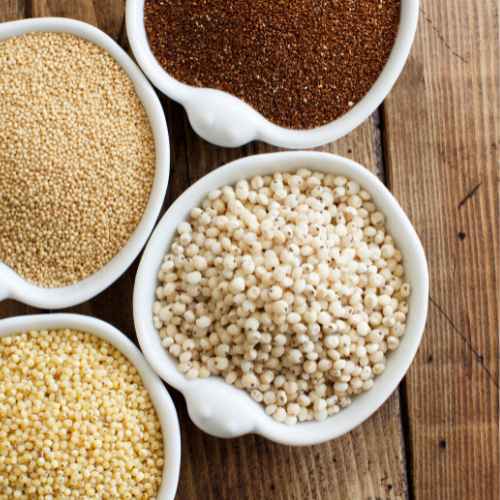
The Paleo diet and the Keto diet are two very different things, yet they share certain similarities that often lead them to be compared or even confused. So, what is the difference between Paleo and Keto?
A Whole Food Approach To Eating
Paleo and Keto are popular dietary approaches that focus on eating whole, unprocessed foods, yet they differ in their primary principles and goals.
The Paleo diet revolves around mimicking the eating patterns of our ancestors, emphasizing natural foods like meat, fish, vegetables, fruits, nuts, and seeds while avoiding grains, legumes, dairy, and processed items.
The Keto diet aims to put the body into ketosis, a metabolic state where fat is burned for energy instead of carbohydrates. This is achieved by adopting a high-fat, moderate-protein, and very low-carbohydrate eating plan.
While both diets focus on healthier choices, their methods and food restrictions cater to different lifestyle and health goals.
Let’s explore the fundamentals of each diet in turn.
What Is the Paleo Diet?
The Paleo diet, often referred to as the “caveman diet,” is based on the idea of eating in a way that mirrors the dietary habits of our ancestors during the Paleolithic era. The central principle is to consume whole, nutrient-dense foods that were likely available to early humans before the advent of agriculture and modern food processing. This means the diet prioritizes foods like lean meats, fish, fresh fruits, vegetables, nuts, and seeds.
The Paleo philosophy centres around the belief that our bodies are better adapted to these natural, unprocessed foods than the grains, dairy, and highly refined products that dominate the modern diet. It aims to eliminate foods introduced during the agricultural revolution, such as legumes, grains, and added sugars, which are thought to contribute to various health issues today.
By focusing on eating real, whole foods and avoiding artificial additives, Paleo enthusiasts strive for improved digestion, reduced inflammation, better energy levels, and overall well-being—all inspired by ancestral eating habits.
What Is the Keto Diet?
The ketogenic diet, often referred to as “keto,” is a low-carb, high-fat diet designed to shift the body into a state called ketosis. Ketosis occurs when the body begins to burn fat for energy instead of carbohydrates, leading to the production of molecules known as ketones. This metabolic state can help improve energy levels, support weight management, and even positively impact certain health conditions.
The foundation of the keto diet lies in significantly reducing carbohydrate intake, typically to less than 50 grams per day, and increasing consumption of healthy fats like avocados, olive oil, nuts, seeds, and fatty fish. Protein is consumed in moderate amounts to meet bodily needs without disrupting ketosis. Foods like sugary snacks, grains, starchy vegetables, and most fruits are typically avoided due to their high carbohydrate content.
By focusing on fat as the primary energy source, the ketogenic diet aims to stabilize blood sugar levels, enhance mental clarity, and promote fat burning. Though initially challenging for some, this way of eating has gained popularity for its potential benefits in managing weight, promoting metabolic health, and supporting overall wellness.
Key Differences Between Paleo and Keto
The paleo diet is based on eating foods that mimic the diet of our hunter-gatherer ancestors, focusing on unprocessed meats, fish, eggs, vegetables, fruits, nuts, and seeds while avoiding dairy, grains, legumes, and processed foods. It prioritizes a clean and natural approach to eating without strict macronutrient requirements. The primary focus is on nutrient density and avoiding modern agricultural products believed to be harmful to health.
On the other hand, the ketogenic diet is centred around achieving and maintaining the state of ketosis by strictly limiting carbohydrates (usually less than 50 grams per day) and increasing fat intake. Unlike paleo, keto is less concerned with the types of foods consumed and more focused on the macronutrient ratios to ensure the body uses fats, rather than carbohydrates, as its main energy source.
Another notable distinction is their stance on dairy. Many keto followers include high-fat dairy products like cheese and butter in their meals, as these are excellent sources of fats and low in carbs. Paleo, however, typically excludes dairy altogether since it wasn’t a staple in ancestral diets.
Ultimately, while both diets have the potential to support healthy living, they cater to different preferences and objectives. Paleo is suited to those seeking a more natural and ancestral approach to eating, while keto is ideal for those aiming for metabolic changes through carb restriction and fat adaptation.
Carbohydrates and Grains on Paleo and Keto
A major crossover between Paleo and Keto in terms of foods and ingredients is the question of carbohydrates and more specifically, grains.
The Paleo diet can be considered grain-free, as grains are not on its list of allowed ingredients. Grains, such as wheat or barley, are not only considered to be a modern industrial food crop but are also thought to contain compounds that are supportive of optimal health.
The Keto diet, whilst not specifically grain-free, does encourage the elimination of grains as they are a major source of carbohydrates.
Oats, wheat and other cereal grains are pretty much off the menu for both diets, so alternatives such as nuts and seeds feature highly in both diets. This keto granola is a great breakfast cereal for both diets.
Explore the keto food list in more detail.
The Benefits of Paleo and Keto
When it comes to health benefits, both Paleo and Keto offer distinct advantages, depending on individual goals and lifestyles.
The Paleo diet emphasizes whole, unprocessed foods, which can lead to improved digestion and reduced inflammation. By eliminating processed grains, dairy, and artificial additives, Paleo can help individuals with sensitivities or allergies, such as lactose intolerance or gluten intolerance. Many followers also report increased energy levels and better blood sugar regulation due to the reliance on nutrient-dense fruits, vegetables, and protein sources.
On the other hand, the Keto diet is well-known for its ability to promote weight loss, particularly fat loss, by encouraging the body to use fat as its primary fuel source. This metabolic state, known as ketosis, not only supports fat burning but can also enhance mental clarity and focus. Additionally, Keto has been linked to potential therapeutic benefits, such as managing certain neurological conditions like epilepsy and even aiding in blood sugar control for individuals with type 2 diabetes.
Both diets encourage a break away from heavily processed foods and sugary snacks, setting the stage for a wholesome approach to eating. However, as with any diet, it’s crucial to consider personal health needs and consult with a healthcare professional when deciding which plan might be best for you.
Who Should Choose Each Diet?
When deciding between the Paleo and Keto diets, it’s important to consider your personal goals, lifestyle, and health conditions.
The Paleo diet might be a great fit if you’re looking to adopt a more natural approach to eating, emphasizing whole foods and avoiding processed ingredients. It’s particularly suitable for those who want to boost their overall health, improve digestion, or lower inflammation, as its focus on nutrient-dense foods supports these outcomes. If you’re an active individual or an athlete, Paleo’s inclusion of healthy carbs like sweet potatoes and fruits can provide the energy needed for performance and recovery.
On the other hand, the Keto diet could be the better choice for those aiming primarily for weight loss, especially fat loss, or individuals managing conditions like type 2 diabetes or epilepsy. If mental clarity and sustained focus are priorities, the ketogenic state may offer additional benefits in these areas. That said, Keto is often stricter in its requirements, demanding careful tracking to maintain ketosis, which may not be ideal for everyone. Those who enjoy structure and are willing to commit to a low-carb, high-fat ratio may find success with Keto.
Ultimately, both diets can be effective when tailored to your needs, and the decision should align with your health goals, preferences, and lifestyle. Consulting a nutritionist or doctor can help ensure the diet you choose is safe and sustainable for you.
Common challenges people face with Paleo and Keto
Adopting either the Paleo or Keto diet can come with its own set of challenges.
For those following the Paleo diet, one of the most common hurdles is the elimination of many modern convenience foods. Eliminating grains, dairy, and processed snacks, can make meal planning and dining out more complicated.
It can also be challenging to maintain a diverse and balanced diet if proper planning isn’t in place.
On the other hand, individuals on the Keto diet often find it difficult to manage the strict macronutrient ratios required to stay in ketosis. This means constantly monitoring carb intake, which can be overwhelming, especially for beginners.
Additionally, some experience the “Keto flu” in the early stages, which can include symptoms like fatigue, headache, and irritability as the body adjusts to burning fat for fuel instead of carbohydrates.
Both diets can be more expensive, as they require higher-quality ingredients.
These challenges highlight the importance of preparation, flexibility, and long-term sustainability when choosing either Paleo or Keto.
A Final Word
As we have seen, both the Paleo and Keto diets offer unique approaches to improving health and achieving personal wellness goals.
While both diets have their benefits they also come with challenges. Maintaining the strict guidelines of these diets can be daunting, and preparation is key. The cost of higher-quality ingredients, compared to a diet of cheap processed foods, is certainly a factor to be considered.
Ultimately, the choice between these diets—or any dietary approach—will depend on your personal health goals, preferences, and lifestyle. It’s always a good idea to consult with a healthcare professional or nutritionist first.
With proper planning, flexibility, and commitment, either diet has the potential to positively impact your health and well-being.
Interested in starting a keto diet? Read our guide to ‘getting started with the keto diet’.
Our grain-free keto granola is suitable for both Paleo and Keto diets.
This article was reproduced on this site with permission from operafoods.com.au the “Keto Granola Supplier”.
See original article:- What Is The Difference Between Paleo And Keto?