
Category: Gourmet Muesli
How Specialty Cereal for Independent Retailers Turns a Single Sale into a Weekly Visit
You spend a lot of energy thinking about how to get people through the door. Much of it goes into promotion and local advertising, in the hope of giving someone a reason to choose your store over the supermarket that’s possibly closer, probably cheaper, and almost certainly open longer. In Australia, where a handful of major chains dominate grocery, nearly every one of your customers shops at one of them.
But the most reliable driver of repeat visits isn’t a promotion. It’s a product someone can’t easily find elsewhere.
This is well understood in categories like deli, bakery, and fresh produce, where independent retailers have always competed on quality and curation rather than price. What’s less obvious is that specialty cereal can do the same job, in a category many stores treat as a commodity. The difference is that cereal has something fresh produce doesn’t: a high repeat-purchase frequency and almost no variability in what people buy.
This article explains how a specialty cereal line turns breakfast, the most habitual meal of the day, into a regular reason for customers to choose your store over the supermarket, and what that loyalty is worth across the whole shop.
Why does specialty cereal bring customers back every week?
Specialty cereal brings customers back because breakfast is the most habitual meal in the house. People eat roughly the same breakfast most mornings for weeks or months at a time. It’s the meal with the least decision-making attached to it. Someone who finds a granola they like will buy it repeatedly with very little prompting, very little comparison shopping, and very little price sensitivity, because switching costs them the one thing they value at seven in the morning, which is not having to think.
This matters for you because a single successful purchase in the cereal aisle can convert into a predictable, recurring visit. Not every category behaves this way. A customer might love your olive oil, but they buy olive oil once every two months. Cereal moves weekly, sometimes fortnightly. The repurchase cycle is short enough that it becomes part of the shopping routine rather than an occasional decision.
How does specialty cereal set independent retailers apart from the supermarket?
Specialty cereal sets your store apart in a way the mainstream brands can’t, because it isn’t sitting on the same supermarket shelf your customer shops every week. Many independent grocers carry the same mainstream cereal brands as the supermarket down the road. Nobody drives past the supermarket to buy them from you. Those brands are interchangeable across every store that stocks them, which means they give no one a reason to choose your store. At the major supermarkets, the cereal aisle is increasingly split between those same brands and the chain’s own label.
Specialty cereal flips this. A specialty granola, Australian-made by a smaller manufacturer and sold direct in formats and flavours the major chains either don’t carry or don’t prioritise, gives your customer something they’re unlikely to find down the road. They come back every week or two because the product has become part of their morning and your store is where they know they’ll find it.
What is a weekly specialty granola customer worth to an independent grocer?
The direct financial value of a destination cereal product isn’t just the margin on the bag. It’s the margin on the basket.
A customer who comes in specifically for their granola doesn’t leave with just the granola. They pick up milk, fruit, and maybe something for dinner. Basket size tends to increase when the visit is purpose-driven rather than opportunistic. A customer on a top-up run spends less than a customer who came in for a specific product and then fills gaps while they’re there.
Over the course of a year, a single customer buying a bag of granola every week or two generates a modest amount of cereal revenue on its own. Yet the basket that surrounds each of those visits, multiplied by however many customers have adopted the same habit, adds up to something considerably more significant. And because the trigger product isn’t one they can price-check at the supermarket, less of that basket value is exposed to the customer switching stores for a cheaper version of the same item. For the margin on the bag itself, read our article on why premium cereal delivers stronger margins than mainstream brands.
Which specialty cereals keep customers coming back?
A specialty cereal keeps customers coming back when it meets three conditions. It needs to taste good enough to become habitual. The product also must be distinct enough from what the major supermarkets carry that a customer can’t find a close-enough substitute elsewhere. And it needs to be consistently available, because nothing kills a destination habit faster than the product being out of stock when someone comes in for it.
Clean-label Australian-made products from manufacturers who sell direct to independents tend to tick these boxes naturally. The clean-label recipe is what makes them taste different from mass-market cereal. They sit outside the range the major supermarkets carry, which is what gives your store the point of difference.
Provenance does some of the work too. Country-of-origin labelling puts the Australian-made claim on the pack in a format your customers already recognise. A customer who can see at the shelf that this is Australian-made granola has one more reason to trust it enough to make it a weekly buy.
If you trade under a banner group, much of your cereal aisle likely comes from the group’s warehouse range. Ranging a specialty line direct from the manufacturer is the same kind of call many independents already make with local bakery and produce suppliers. It also gives you more control over availability.
What should independent grocers look for in a specialty cereal supplier?
When you’re choosing a specialty cereal supplier, the range matters most, because every product that meets a different need can bring a different customer back each week.
A high-protein keto granola holds one customer, a gluten-free paleo blend another, a Bircher muesli someone else again. Each is a habit your store owns, and a supplier with that breadth lets you build several from a single order. If you’d rather start with a few lines and see which habits take hold, read our article on how small order wholesale cereal lets you test new lines without the risk.
The value of specialty cereal in your store isn’t really about cereal at all. It’s about owning a reason for someone to come back, in a category where coming back means coming back every week. You probably already have destination products in your fresh departments. The cereal aisle is an opportunity to build the same loyalty in a shelf-stable category with far less waste risk and all the repeat-purchase frequency.
If you’re looking for the lines that bring customers back every week, you can explore the full range on the Plum Foods wholesale breakfast cereal page.
This article was reproduced on this site with permission from operafoods.com.au the “Cereal for Retailers Suppliers”.
See original article:- How Specialty Cereal for Independent Retailers Turns a Single Sale into a Weekly Visit
How Small Order Wholesale Cereal Lets You Test New Lines Without the Risk
You can see that the breakfast cereal category is changing. Customers are asking for granola, for gluten-free options, for something beyond the usual supermarket boxes. But acting on that means committing to stock, and for a small store, committing to the wrong stock is expensive in ways that go beyond the invoice.
A pallet of product that doesn’t move doesn’t just tie up cash. It takes up space that could be earning. It sits there reminding you that you guessed wrong. This is why many independents are slow to experiment, and it’s why their cereal aisles end up looking like a scaled-down version of the big chains. Safe, familiar, and not particularly profitable.
Small order wholesale cereal changes this equation.
The practical question is how to move from a single test carton to a cereal range that reflects what your customers actually buy, without the financial risk of committing to stock that might not move. That starts with understanding how carton-level wholesale works, runs through setting up a trial that produces usable data, and ends with a repeatable ordering cycle that builds your range one decision at a time.
How does small order wholesale cereal work?
When manufacturers talk about small order wholesale, they’re usually talking about carton-level quantities rather than pallet-level. For a typical premium granola or muesli range, that might mean twelve 500g bags per carton, or six 1kg bags. A low minimum order, common among Australian manufacturers selling direct, gets you enough product to trial three or four SKUs at once without betting your working capital on any single one.
Buying direct from a manufacturer at carton quantities means you can trial a product the way you’d trial anything else in your store. Put it on the shelf, see how it performs over a few weeks, and reorder what sells. The risk sits where it should: proportional to the test, not to the supplier’s logistics model.
How do you trial new cereal lines in a small store?
Testing a new cereal line isn’t just about buying a carton and hoping. There’s a method to it, and it starts with thinking about what you’re trying to learn. The question is not “will this sell?” in the abstract. It’s “will this sell here, to my customers, at this price point, in this position on the shelf?”
A useful trial gives you clear answers. Stock two or three products from the range, not one, because a single SKU can fail for reasons that have nothing to do with demand. Put them where the customer looking for healthy cereal will see them, not buried at the end of the aisle behind the oats. Price them at the recommended retail, not discounted. You’re testing whether the product can sustain its margin, not whether you can give it away.
Give it three to four weeks. If a 500g bag is moving at even two or three units a week in a small store, that’s a signal. A 1kg format outselling the 500g tells you something about your customer base. They’re not trialling, they’re buying for the household. Nothing moving after four weeks is an answer too, and it cost you a few cartons to get it. That’s low-cost market research.
For a closer look at the financial case, read our article on why premium cereal delivers stronger margins for independent retailers.
What does a cereal trial actually tell you?
The trial tells you what moved. The reorder decision is about why it moved and what to do about it.
If one SKU carries all the volume while the others sit, the range is not the draw. That specific product is. Reorder it and replace the slower lines with something different rather than restocking the same set. If two or three SKUs sell at similar rates, the range itself is working, and your reorder should reflect the full mix.
A carton that sells through in two weeks rather than four is telling you something different from a carton that sells steadily over the full trial. Fast sell through means you need more shelf space for that product, not just another carton on the same timeline. Steady movement at two or three units a week means the product has found its pace and your reorder quantity is about maintaining supply, not expanding position.
How do you build a cereal range without overcommitting on stock?
The real power of small order wholesale isn’t in the single trial. It’s in the ability to build a range incrementally, one carton at a time, based on what your store’s data is telling you.
Your first order covers different needs. A classic granola, a gluten-free option, perhaps a keto or high-protein line. See which ones your customers respond to. Reorder the performers, drop the ones that don’t land, and test the next product in the range. Over two or three ordering cycles you’ve built a curated cereal section that reflects actual local demand, not a planogram designed for a different kind of store.
This is what gives independents an edge. Not replicating the major supermarkets’ range but reading your own customers and stocking accordingly. It turns the cereal aisle from a fixed cost into an iterative experiment, where every carton teaches you something and the cost of a wrong call is a single carton, not a pallet.
What should you look for in a wholesale cereal supplier?
If you’re building a range one carton at a time, the supplier matters as much as the product.
Australian-made matters to the customer. It’s a trust signal that supports the price point at retail. It’s a reason to buy that the customer already understands.
Award-winning products reduce the selling effort at shelf. They give the product a credential that does some of the work your staff would otherwise have to do, which matters when you’re introducing a line your customers haven’t seen before.
And reliable reorder matters more than it sounds. The whole point of the iterative approach is that you reorder what sells. If the product you’ve built demand for goes out of stock because your supplier can’t turn around a small order reliably, you lose the momentum the trial created.
If you want to trial premium cereal at carton quantities, you can explore the benefits and request wholesale pricing from the Plum Foods wholesale cereal page for independent retailers.
This article was reproduced on this site with permission from operafoods.com.au the “Cereal for Retailers Suppliers”.
See original article:- How Small Order Wholesale Cereal Lets You Test New Lines Without the Risk
Why Premium Cereal for Independent Retailers Delivers Stronger Margins than Mainstream Brands
You probably stock breakfast cereal the same way you always have. A few mainstream brands take up most of the shelf, chosen because they’re familiar and they move. The margins are thin, but the volume is reliable, and nobody gets fired for stocking frosted flakes.
The problem is that this logic was built for a version of the cereal aisle that no longer exists. Category data across Australian retail shows granola and muesli growing steadily while traditional breakfast cereals flatten or decline. The shopper standing in front of your shelf in 2026 is not the same shopper who stood there ten years ago.
A growing share of them are actively looking for something the mainstream brands don’t offer, whether that’s clean-label granola, low-sugar muesli, or gluten-free options that actually taste like something. When they can’t find it in your store, they’re not switching to cornflakes. They’re going somewhere else. That’s where premium cereal starts to make financial sense for your store, and it has nothing to do with chasing a trend.
This article walks through why the margins work, from shelf-space arithmetic and price positioning through to on-shelf performance and what to look for in a supplier.
What margins does premium granola earn per shelf metre?
The first thing to understand is that premium cereal operates on a different margin structure to mainstream. A 500g bag of clean-label granola from an Australian manufacturer might wholesale at two to three times the unit cost of a mass-market box. But it retails at a price point where the per-unit margin, in dollars rather than percentage, is stronger.
But what matters even more for your store is the return per metre of shelf space. A mainstream cereal might turn faster, but if four facings of premium granola generate the same gross profit as eight facings of a national brand, the granola is earning its space more efficiently. You have limited shelf real estate, as every independent does, and that’s the number that counts.
How does premium cereal protect you from price competition?
If you’re competing on price against the major supermarkets, you’re playing a game with a known outcome. The big chains will always have more buying power, more promotional support, and more willingness to use cereal as a loss leader to drive foot traffic. Stocking the same mainstream brands at competitive prices is a race to the bottom you cannot sustain.
Premium cereal sidesteps this entirely. A customer buying a bag of Australian-made granola is not comparing your price to the supermarket down the road. They’re buying something the big chains either don’t stock or bury in a health-food aisle that feels like an afterthought. The purchase decision is driven by product quality and availability, not by price comparison. That’s the only terrain where you have a structural advantage.
This is a margin argument as much as a competitive one. When a product isn’t being shopped on price, you’re not under pressure to discount it. The margin you set is the margin you keep.
How does premium granola perform once it’s on the shelf?
One of the advantages of premium cereal is how it behaves once it’s on the shelf. Clean-label products with short ingredient lists and genuinely good taste tend to build habitual buyers faster than mainstream alternatives. The customer who tries a bag of premium granola and likes it doesn’t go back to scanning the cereal aisle. They come in looking for that specific product.
What this means for margin is less obvious but more important than the per-unit number. A habitual buyer costs you almost nothing to retain. You’re not running a promotion to move the product, which means the margin you built into the retail price stays intact rather than being eroded by a two-for-one or an end-of-aisle discount. You’re not absorbing dead stock because it sat too long.
Product that moves on a predictable cycle doesn’t get marked down or written off on your shelves, and in a perishable-adjacent category like cereal that matters more than you might think. And you’re reordering on a rhythm you can plan around, which means tighter inventory management, fewer emergency top-ups, and less cash sitting on the shelf between deliveries. Every one of those factors feeds margin. Not on the price tag, but on the cost side of the equation that you might not be factoring into your shelf decisions.
What should you look for in a wholesale cereal supplier?
Not all premium product is created equal, and if you’re choosing a supplier for the first time you should be evaluating the relationship through a margin lens, not just a product one.
Australian-made matters to the shopper. It’s a trust signal and a differentiator against imported health-food brands that trade on packaging more than provenance. But it also matters to your margin, because Australian provenance supports the price point at retail. It’s a reason to buy that the customer already understands.
The practical details matter just as much. Buying direct from the manufacturer, without a distributor margin layered in, protects your per-unit number at the point where it’s most vulnerable. And award-winning products reduce the selling effort at shelf. They give the product a credential that does some of the work your staff would otherwise have to do, which is a labour cost most stores don’t think of as a margin factor.
The question isn’t whether premium cereal belongs in your store. It’s how much shelf space you’re currently giving to low-margin mainstream product that could be earning more for every centimetre it occupies.
If you’re ready to see what premium cereal could do for your margins, request wholesale pricing and samples from the Plum Foods wholesale cereal page for independent retailers.
This article was reproduced on this site with permission from operafoods.com.au the “Cereal for Retailers Suppliers”.
See original article:- Why Premium Cereal for Independent Retailers Delivers Stronger Margins than Mainstream Brands
Bircher Muesli – A Great Way To Start Your Day

A healthy breakfast favourite for many, Bircher muesli offers a unique, softer texture compared to traditional porridge. It is perfect for those looking for a meal at the start of the day that’s easy to eat and digest. Both indulgent and wholesome, it is the ideal choice for those seeking a nutritious and satisfying breakfast.
But what is Bircher muesli exactly, and just how healthy is it?
What is Bircher muesli?
Bircher muesli is a Swiss breakfast that dates back to the early 1900s. Created by Swiss physician Maximilian Bircher-Brenner, this nutritious dish consists of rolled oats soaked overnight in either milk, yogurt, or juice. This allows them to soften and absorb the flavours.
The original recipe was intended to increase his patients’ fruit intake, whilst also being easy to eat and gentle on the stomach. It includes hazelnuts and grated apples, soaked overnight along with the oats.
It is hard to beat the perfect simplicity of the original recipe, but Bircher muesli is easily adaptable. You can switch up the fruits or nuts, or even add seeds.
What is the difference between overnight oats and Bircher?
Strictly speaking, not much. Nowadays, it comes down to semantics more than anything else. Yet there are some subtle differences between overnight oats and Bircher muesli.
Overnight oats and Bircher muesli are both popular breakfast options that involve soaking oats.
Overnight oats typically involve oats soaked in milk or yoghurt overnight. These can then be customised with a variety of toppings such as fruits, nuts, and sweeteners like honey or maple syrup. The soaking process softens the oats, but the toppings add a variety of textures.
Bircher muesli, on the other hand, also starts with oats soaked in milk, yogurt, or even fruit juice. The ingredients however (traditionally hazelnuts and apples) are all soaked together overnight. Made in this way, it becomes a softer and more easily digestible breakfast closer to the spirit in which it was intended.
What makes Bircher muesli different from regular muesli?
Although you can now find Bircher muesli blends alongside the muesli in the cereal aisle (spoiler alert; our hinterland bircher muesli blend is one of them) they are different things.
Unlike Bircher muesli, regular muesli is not soaked overnight, which means it retains a variety of contrasting textures and tastes. The key distinguishing factor for Bircher muesli is its preparation style. Soaked overnight, this softens the oats and integrates the flavours of the added ingredients, resulting in a creamy and cohesive dish.
Is Bircher muesli healthy?
Bircher muesli is only as nutritious as you make it, depending on the ingredients you choose to include. If you use cream and a significant amount of nuts, the calorie content will be higher compared to making it with water. However, when prepared with the core components of oats, fruit, nuts, and milk it becomes a wholesome breakfast option, offering an array of nutritional benefits.
Nutritional value of oats
- High in Fibre: Oats are an excellent source of dietary fibre, particularly beta-glucan, which helps regulate blood sugar levels and cholesterol.
- Rich in Protein: They contain more protein than most grains, providing essential amino acids that are vital for body repair and maintenance.
- Packed with Vitamins and Minerals: Oats are a good source of essential vitamins and minerals, including manganese, phosphorus, magnesium, copper, iron, zinc, folate, and B vitamins.
- Antioxidant-Rich: They contain unique antioxidants known as avenanthramides, which have anti-inflammatory and anti-itching properties.
- Low in Calories: Despite their richness in nutrients, oats are relatively low in calories which makes them an excellent choice for weight management.
Fruit is always a good thing, yet apples are a particularly good choice.
Nutritional benefits of apples
- High in Fibre: Apples are rich in the soluble fibre pectin, which aids in digestion and promotes a feeling of fullness, helping with weight management.
- Vitamins and Minerals: They are a good source of vitamins like vitamin C and various B vitamins that support immune function and boost energy levels.
- Antioxidants: Apples contain powerful antioxidants such as quercetin and flavonoids that help protect cells from oxidative stress and reduce the risk of chronic diseases.
- Hydration: With high water content, apples contribute to hydration and assist in maintaining skin and overall body health.
- Low in Calories: Despite their sweetness, apples have a low-calorie count, making them a satisfying and healthy snack option.
This makes apples a perfect addition to Bircher muesli, enhancing its taste and nutritional value.
Nutritional value of nuts
Nuts offer a wealth of benefits packed within their small size.
They are an excellent source of healthy fats, primarily monounsaturated and polyunsaturated fats, which are known to support heart health. Nuts are also rich in protein, making them a great plant-based protein source for vegetarians and vegans.
Additionally, they provide important vitamins and minerals, including vitamin E, magnesium, and selenium, which play crucial roles in maintaining various body functions. The fibre content in nuts contributes to digestive health and promotes a feeling of fullness, aiding in weight management.
Furthermore, nuts contain antioxidants that help fight inflammation and oxidative stress, reducing the risk of chronic diseases. Including a variety of nuts in your diet can be a delicious and effective way to enhance your nutritional intake.
Hazelnuts, in particular, contain high levels of vitamin E, which is beneficial for skin health and may promote anti-ageing effects. Almonds are rich in magnesium, which is essential for bone health and muscle function. Walnuts contain omega-3 fatty acids that support brain health and help reduce inflammation. And cashews are a good source of zinc, which plays a role in immune function and wound healing.
Nutritional value of dairy
You can choose to make your Bircher muesli with water, juice or alt-milk, but dairy foods have long been considered a key component of a healthy breakfast.
Nutritional value of dairy milk and yoghurt
- Calcium: Both dairy milk and yoghurt are excellent sources of calcium, essential for building and maintaining strong bones and teeth.
- Protein: They provide high-quality protein essential for muscle repair and growth, and also help in maintaining overall body strength.
- Vitamins: Dairy milk and yoghurt contain several important vitamins. Vitamin D, which aids in calcium absorption. B vitamins like B2 and B12 are critical for energy production and red blood cell formation.
- Probiotics (in yoghurt): Yoghurt is rich in live beneficial bacteria, which help maintain gut health by balancing the gut flora and aiding digestion.
- Potassium: Consuming dairy milk and yoghurt provides a good amount of potassium, which helps regulate fluid balance, nerve signals, and muscle contractions.
- Phosphorus: An essential mineral found in both dairy products, phosphorus works with calcium to support healthy bones and teeth.
By incorporating dairy milk or yoghurt into your Bircher muesli, you can enhance its nutritional profile and enjoy the creamy texture and delicious taste it offers.
Is Bircher muesli gluten free?
The answer all depends on who is asking and why. The subject of gluten-free oats is a contentious one.
Many of us have heard that oats are naturally gluten-free, yet because they are frequently processed in facilities with gluten-containing grains, they can’t be classified as gluten-free. Yet oats do contain their own type of gluten, which may trigger sensitivities in some.
While avenin, the protein found in oats, might trigger a response in some individuals with gluten intolerance or celiac disease, it’s not a guaranteed reaction. Any sensitivity to oats could be specifically due to avenin, potential contamination from other grains during processing, or possibly a combination of both factors.
Can you eat Bircher muesli without soaking it?
Bircher muesli is designed to be soaked. It is kind of the point. The soaking process not only softens the oats, making them easier to digest but also helps reduce phytic acid. This is a compound found in grains that can hinder mineral absorption. Including nuts in the soaking process can further aid digestion, but note that they will lose some of their crunchiness.
How do you make Bircher muesli?
To make Bircher muesli, start by combining rolled oats with milk (or yogurt for extra creaminess). Add in grated apples for a bit of natural sweetness and a handful of chopped nuts. Mix everything well to ensure the ingredients are well-integrated. Once combined, cover the bowl and let it soak in the refrigerator overnight.
Vegan Bircher muesli
You can make it vegan by simply replacing dairy milk or yogurt with plant-based alternatives like almond milk, soy milk, or coconut yogurt. You could also use water or fruit juice.
Try matching your alt-milk to your nuts, or oat milk is a particularly creamy choice with a naturally soft sweetness all of its own.
Classic Bircher muesli recipe
The moreish simplicity of classic Bircher muesli just cannot be denied. But don’t forget you can make it your own by switching out your liquid, your fruit, or your nuts.
Serves 1
90ml milk
1 apple, coarsely grated
1/4 cup hazelnuts, chopped
- There’s only one step to this recipe. Mix everything together and refrigerate overnight.
As we have seen, Bircher muesli offers a great start to your day with a dish that’s simple to prepare. Whether you prefer the classic version or wish to experiment with vegan alternatives, the key is in the soaking, which unlocks both texture and flavour. With minimal ingredients and a flexible recipe, you can personalise your Bircher muesli to suit your taste preferences and dietary needs.
So, why not give it a try and enjoy a healthy breakfast that feels like a treat every morning?
Have you explored our full range of healthy cereals yet? Or you could try one of our bircher muesli blends.
This article was reproduced on this site with permission from operafoods.com.au the “Healthy Cereal Wholesaler”.
See original article:- Bircher Muesli A Great Way To Start Your Day
Is Muesli Good for You?
It is a breakfast staple for many, but is muesli good for you? In this article, we explore the role that muesli can play as part of a healthy breakfast and why it can (but not always) be a nutritious choice. We’ll also guide you on how to choose a healthy muesli and share some ideas for mixing it up a bit.
Let’s start with the basics.
What is Muesli?
This may sound like a silly question, but if sugary cereals have always been more your thing, then you could be forgiven for misunderstanding muesli.
Muesli is a (potentially) wholesome, uncooked breakfast dish that first originated in Switzerland. It’s typically made up of a base of rolled oats combined with various ingredients like dried fruits, seeds, and nuts. Some versions also include other grains, such as barley or rye flakes. Unlike granola, which is usually baked with sweeteners and oil, it is often eaten raw or soaked overnight in milk or yogurt.
There’s also toasted muesli which, as the name suggests, is muesli that has been toasted. Not quite granola, it does however have a crisper texture and more baked flavours than the regular stuff.
What’s muesli made of?
As we have seen, muesli is traditionally made from a base of rolled oats with other ingredients such as dried fruit and nuts added. But that’s not the whole story.
Is muesli full of sugar?
It can be. Many commercial brands can contain as much as 20% sugar. Luckily there are plenty of options that are low or no sugar. Watch out for natural forms of sugar too. Whilst sweeteners such as honey and maple syrup are preferable from a nutritional standpoint, they should still be lower down the list of ingredients. It is probably best to stay away from artificial sweeteners too, as the evidence against them continues to grow.
Wholegrain Cereal for a Healthy Breakfast Option
A healthy breakfast is crucial as it kick-starts your metabolism and provides the energy needed to see you through the day. It helps regulate your blood sugar levels, keeping you satiated and preventing overeating later in the day.
Additionally, a nutritious breakfast that includes a balance of protein, fibre, and good fats can improve cognitive function, helping you to concentrate throughout the day.
So, starting your day with healthy breakfast cereals such as muesli could be a great way to ensure you’re feeding your body right from the word go, and the first step towards a healthy diet. Read our article to find out more about why wholegrains are the heart of a healthy cereal.
The Benefits of Muesli
Is muesli healthier than oats?
It all depends. A traditional muesli made with oats will give you all the benefits of oats plus the additional nutrients of the fruit, nuts and seeds. But there are things to watch out for, as we will see later on.
The plus side
On the plus side, muesli is a great source of wholegrain fibre, vitamins and minerals.
Boosting your fibre intake comes with a host of health benefits. A fibre-rich diet aids digestion by adding bulk to the stool, helping prevent constipation and promoting regular bowel movements. Additionally, it can contribute to weight management by inducing a feeling of fullness, which can help curb overeating. Fibre can also play a crucial role in maintaining heart health by reducing levels of ‘bad’ LDL cholesterol, thereby reducing the risk of heart disease.
The unique soluble fibre in oats has been shown to have additional benefits such as improving insulin sensitivity, reducing inflammation and balancing gut microbiota.
It is also home to many essential vitamins and minerals, each contributing to various aspects of overall health. Packed with magnesium, iron, zinc, and B vitamins from whole grains, muesli aids in energy production and promotes a healthy nervous system.
The added nuts and seeds contribute healthy fats, as well as vitamin E, and selenium, which are known for their antioxidant properties and support for the immune system.
Dried fruits like raisins or apricots, are a good source of potassium and vitamin A.
However, it’s important to note that the nutritional profile can vary greatly depending on the specific ingredients used in each blend.
The downsides
Despite its numerous health benefits, muesli does have a few downsides that are worth considering.
First and foremost, some muesli blends can be high in sugar, particularly those that contain added sugars or a high proportion of dried fruits. Consuming excessive amounts of sugar can lead to weight gain, tooth decay, and increased risk of various health issues such as heart disease and type 2 diabetes.
Secondly, some store-bought muesli mixes may contain high amounts of sodium, which could contribute to high blood pressure if consumed in excess.
Lastly, muesli is calorie-dense, meaning it can be easy to overdo it, which could potentially lead to weight gain if not portion-controlled. As with any food, even those with numerous health benefits, moderation is key.
How to Choose a Healthy Muesli
When choosing a healthy muesli, there are a few key aspects to consider.
Firstly, opt for a brand that uses whole grains as the base, as these are packed with fibre and keep you feeling full for longer. However, if you choose not to eat grains there are some excellent grain-free muesli options available.
Our crispy apple paleo is a great little grain-free muesli
Secondly, pay close attention to the sugar content. As mentioned earlier, some brands can contain up to 20% sugar, so aim for options that are low or no sugar. Natural sweeteners are preferable, but they should not be a primary ingredient.
Also, look for a muesli that includes a variety of nuts and seeds for added protein and healthy fats. Dried fruit does contain sugar, albeit in a more nutritious package, but a variety of fruits will offer a range of vitamins and minerals.
Finally, be wary of unnecessary additives or preservatives – the fewer ingredients, the better. Stick to these guidelines, and you’ll be well on your way to choosing a nutritious, delicious bowl of muesli.
Our low sugar muesli varieties are made with no artificial preservatives, sweeteners or colours
What Can You Eat Muesli With?
Can I eat muesli without milk?
Whilst we wouldn’t recommend a bowl of dry muesli for breakfast (nosebag, anyone?) there are alternatives to the old-school cereal/combo routine.
Ideas for what to eat with muesli
- Yogurt Parfait: Layer your muesli with Greek yogurt and fresh fruits for a nutritious and visually appealing breakfast option. You can also add a drizzle of honey or a sprinkle of chia seeds for extra flavour and nutrients.
- Smoothie Bowl: Blend your favourite fruits with a bit of almond milk or coconut water and top it off with a hearty sprinkle of muesli. It’s a delicious, filling, and nutritious start to your day.
- Protein Shake: Top your protein shake with toasted muesli for a bit of extra crunch and a nutrient boost.
- Baked Goods: Use muesli in place of oats in your baking to add an extra dimension to your favourite baked goods. Think super easy muesli bars or flapjack. Or banana muffins maybe.
- With Plant-Based Milk: For a vegan option, try your muesli with almond milk, oat milk, or soy milk. You could also consider adding some fresh fruits or nuts on top.
- Quick Muesli Bars: Combine muesli with nut butter and honey, press into a pan, and let it set in the fridge. Cut them into bars for a quick and healthy snack on the go.
- Chocolate and Berries: For a decadent yet healthy dessert, mix your muesli with dark chocolate chunks and berries, then serve it with a dollop of whipped cream or Greek yogurt.
There are plenty of creative ways to enjoy muesli that go beyond the traditional milk and cereal combo. Whether you’re looking for a nutritious breakfast, a filling snack, or a healthy dessert, muesli offers versatility and countless options to suit your dietary needs and preferences.
Explore our range of healthy cereals to buy online. Don’t forget that you can buy in bulk and take advantage of wholesale discounts.
This article was reproduced on this site with permission from operafoods.com.au the “Healthy Cereal Manufacturers”.
See original article:- Is Muesli Good for You?
Why Oats are Still the Backbone of a Healthy Cereal
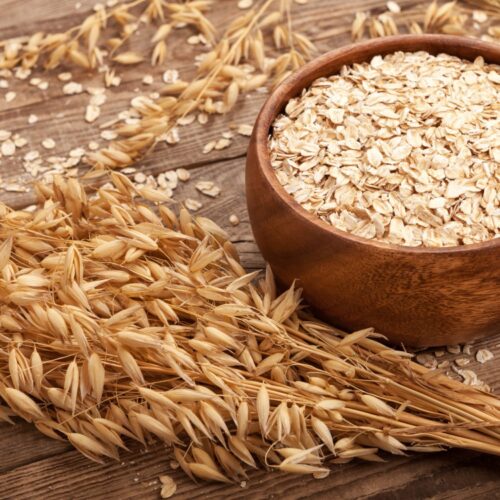
What with keto, and the controversial avenin/gluten content debate, oats have begun to get as much bad press as wheat. Yet the truth is that its very low in gluten and unless you have clearly identified that avenin causes you problems, then you should strongly consider including oats as a regular part of your diet.
The Heart of a Healthy Cereal
At Opera Foods we take our breakfast pretty seriously. We spent a long time considering ‘what makes a healthy breakfast‘ and reached the conclusion that wholegrain cereal is the healthiest breakfast of them all.
So what does that mean? Certainly not all wholegrain cereals are equal. Staying away from the big commercial brands, especially those marketed towards children, is probably a good start. When choosing a healthy cereal, muesli, granola, and porridge, are at the top of most people’s lists.
Speciality blends (such as keto or Paleo ) aside, most of these breakfast cereals have one thing in common. And that is oats. If wholegrains are truly the heart of a healthy cereal, then oats are most definitely the backbone.
Oats in Granola
The entire point of granola is those crunchy, possibly even chewy, clusters. It is one of the things that sets granola apart from muesli. Btw, which side are you on? This may help; muesli vs granola.
We have lots of lovely oat based granola blends for you to try. As well as a few that aren’t.
Oats in Muesli
When Mr Bircher first created his restorative recipe, he didn’t reach for the buckwheat or the quinoa. He choose to base his easily digestible breakfast around the restorative power of oats.
Have you tried our premium muesli blends?
Oats in Porridge
Likewise, generations of Scots have started their day on a warming bowl of porridge oats, which are a staple ingredient in Scotland. Granted, this is largely because they grow really well there and traditional foods do tend to evolve through availability. Yet oats behave in a certain way when cooked in liquid that makes porridge so appealing. They have a certain creaminess, even when cooked in water, that is inherently easy to eat. A bowl of porridge at breakfast will certainly see you through to lunch, and possibly all the way though to dinner. It is just that good.
Our five grain porridge blend is based on organic jumbo oats.
The Health Benefits of Oats
Oats have a ton of beneficial properties and can be considered a true superfood. Which is why we recommend that you only eliminate them from your diet if the downsides outweigh the good.
In short, oats can…
- help lower cholesterol
- help control insulin secretion
- help lower anxiety
- prevent blood sugar spikes
- soothe your gut
- supercharge your skin
Which is quite a lot for an unassuming and often misunderstood little grain. So how do oats manage to provide all these benefits. What supercharges this super grain?
Beta – glucan; heart healthy fibre
Beta-glucan is a soluble fibre found in many grains, yet is particularly abundant in oats.
Soluble fibre dissolves in water to form a gel, unlike insoluble fibre that passes straight through. Although both are types of fibre, they actually have the opposite effect on the body. Together they provide powerful protection for your gut.
The mucus-like gel coats and lubricates the gut lining, slowing down digestion and keeping you fuller for longer. This, in turn slows down the absorption of sugar and helps to stabilise blood sugar levels as well as improve overall blood sugar regulation.
Beta-glucan has been shown to to drastically lower LDL (unhealthy) cholesterol levels, leading to a marked improvement in total cholesterol.
Essential mineral magnesium
Things rarely work in isolation, especially when it comes to health and nutrition. Oats are known to be one of the best foods for helping to control blood sugar levels. Not only does the beta glucan help with blood sugar regulation, but oats are also a rich source of magnesium that helps to regulate insulin secretion. A diabetic double whammy, if you like.
Gramine; nature’s sedative
Oats are a traditional remedy for insomnia, depression and anxiety. We now know that they contain the alkaloid gramine, that acts as a natural sedative.
Water loving polysaccharides
Oats are also well known for their skin softening properties, and again feature highly in traditional beauty remedies. Their excellent moisturising properties are down to the sugars that they contain, which attract and hold water to lubricate the skin.
Silica; skin care’s best kept secret
The mineral silica is involved in the making of collagen and elastin, which provides the structure for firm youthful looking skin. It is also found in hyaluronic acid (yes, that one) which helps to keep the skin matrix supple.
Tocotrienol; skin soothing vitamin E
Oats are very soothing for the skin. They contain a compound known as tocotrienol, which is actually a member of the vitamin E family. As well as its skin soothing properties, it is thought to offer some protection against UV damage too.
Zinc; for problem skin and hair
As if all of this were not enough, oats also contain zinc, which is helpful in controlling sebum production. Greasy hair and breakout skin are often caused by out of control sebum production, and zinc can certainly help with this.
So that’s the lowdown on why oats are such a valuable part of a healthy diet, unless of course you do have issues with avenin sensitivity. Oats are very low in Gluten. In the USA they allow it to be called Gluten Free. Including them in your diet may reap more rewards than excluding them so we believe it is well worth serious consideration.
As always, feel free to explore our range of premium healthy cereals, available to buy online in bulk today.
This article was reproduced on this site with permission from operafoods.com.au the “Australian Breakfast Cereal Manufacturers”.
See original article:- Why Oats are Still the Backbone of a Healthy Cereal
Quinoa Flakes: Spotlight on Whole Grain Cereals
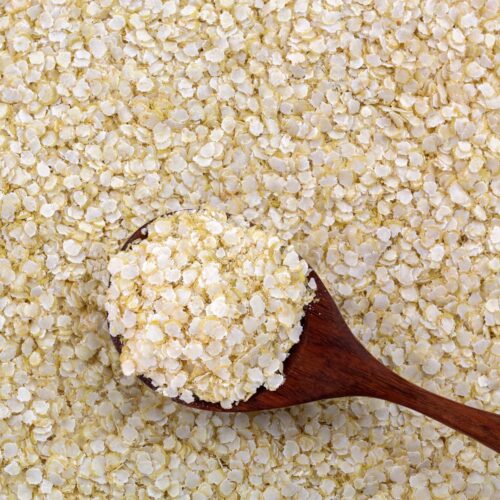
What are quinoa flakes? Healthy cereal, especially muesli and granola, goes way beyond wheat. We have already looked at how wholegrains are the heart of a healthy cereal, and would now like to investigate some of these healthy grains in more detail. Starting with quinoa flakes.
Quinoa in your breakfast cereal
With more and more people on the lookout for healthy breakfast cereals that will meet their dietary needs, or even just a bit more interest in their morning bowl, quinoa has found itself in the ingredients list of many a premium muesli or granola.
Most of us are, by now, familiar with quinoa as an ingredient. Something we may cook instead of rice, or stir into a healthy grain salad. It looks like a round seed, bigger than chia, that softens and expands when cooked. But breakfast cereal requires a different approach. Raw, whole grains are completely unpalatable. Yet cooked grains are no longer dry; a state which is kind of crucial to the whole concept. The answer lies, and always has, in some kind of mechanical processing.
So, you will find quinoa in your breakfast cereal in two forms. Puffed quinoa, and quinoa flakes. Puffed quinoa is less raw than quinoa flakes as it is popped using heat (like puffed rice). Quinoa flakes, on the other hand, are pressed raw (like rolled oats). Both forms are just alternative versions of whole quinoa, so have the same nutritional benefits and properties.
Quinoa flakes are found in our 5 Grain Porridge mix, as well as our gluten-free granola Maple Nut Crunch.
Is quinoa a grain?
Unlike true grains, quinoa is the seed of a plant rather than a cereal grass. We think of it as a grain, as it behaves in very much the same way, but it is a pseudograin, not a true grain.
Are quinoa flakes gluten free?
Yes, quinoa flakes are gluten free.
Is quinoa a carb or a protein?
Quinoa is both carb and protein. As a grain-like food we tend to cook and serve it like a carbohydrate, and it does indeed contain carbohydrates. But it also provides us with all the essential amino acids and is considered a complete protein. For that reason, it has bonafide superfood status.
What does quinoa taste like?
Quinoa tastes slightly sweet and nutty. It does have a little bitterness, with grassy undertones. The taste and texture of quinoa flakes is not unlike rolled oats; when toasted they are more nutty and sweet.
Are quinoa flakes healthy?
Quinoa flakes share all the nutritional benefits of quinoa, which is higher in nutrients than most grains.
Good for your heart –
Omega-3 fatty acids help to reduce the LDL cholesterol that leaves fatty deposits on the walls of the arteries, increasing the risk of heart attack. They also help to reduce inflammation.
Good for growth and repair –
One of the best sources of plant protein, quinoa helps to keep hunger at bay and therefore maintain a healthy weight. It is particularly rich in amino acid lysine, which is important for tissue growth and repair and is believed to be particularly effective at burning fat.
Full of antioxidants –
A great source of antioxidant vitamin E (hello healthy skin), quinoa is also rich in the polyphenol quercetin; another powerful antioxidant.
Rich in minerals –
Quinoa is an abundant source of minerals. There’s…
Manganese for metabolism.
Phosphorus for bones.
Iron for blood.
Copper for the heart.
Quinoa flakes are also really easy to digest, which makes them perfect for breakfast.
Explore our range of healthy cereals, all of them packed full of wholegrains and other natural ingredients.
Or find out more about what makes a healthy breakfast.
This article was reproduced on this site with permission from operafoods.com.au the “gourmet cereals manufacturer”.
See original article:- Quinoa Flakes: Spotlight on Whole Grain Cereals
Cereal smackdown – muesli vs granola

Are you a diehard devotee of granola or do you prefer your healthy breakfast with a little less crunch? Do you think muesli got a raw deal whilst granola evolved into muesli plus?
It’s a cereal smackdown but who will win the battle of muesli vs granola?
The difference between granola and muesli
If you stood the main ingredients of muesli and granola side by side they would be fairly similar. A healthy breakfast of wholegrains, nuts, seeds, and dried fruit, the major difference between granola and muesli is that muesli is raw whilst granola is baked. To facilitate this baking, and turn raw wholesome muesli into crunchy granola, oil and sugar are added. But there is more to granola than just oil and sugar, and in fact it never evolved from muesli at all.
Which came first – muesli or granola?
Most of us are by now familiar with the story of Bircher muesli and how it came about. But did you know that Bircher muesli was actually the first muesli invented? Never intended as a breakfast food, Swiss muesli was the poster child of healthy living. Other parts of Europe soon caught on, enticed by the clean image of fresh mountain air and pastures green. By 1960, commercial muesli was widely available.
Granola began life in the United States yet it was not the lovechild of muesli and flapjack at all. Muesli and granola both came into being around the end of the nineteenth century but the original granola was made from wheat, not oats. It was not until the 1960s that fruit and nuts were added by health conscious hippies, and commercial granola was not available until the 1970s. As it turns out, the two cereals may share many similarities but are in fact completely different things.
Muesli vs granola
So, other than grains, nuts, seeds and fruit, what’s in the bag? Many commercial brands of muesli may have sugar and milk powder added. If your muesli makes the milk taste rich and sweet, chances are it has plenty of both. Gourmet muesli has far less, if any, of these additions. Granola will have some form of fat, and some form of sweetener, added. What these actually are will vary. Commercial varieties of granola are unlikely to be made with butter as it would turn rancid quickly, but they can contain high amounts of unhealthy hydrogenated or trans fats. Sugar content will vary from refined white sugars and corn syrup to the more acceptable face of honey or maple syrup. Even then, quantity counts.
Muesli is served cold, with milk or juice added. It can be soaked, as in Bircher muesli or overnight oats, or even cooked and served hot like porridge. Muesli is pretty versatile but you probably wouldn’t want to snack on a dry handful straight from the box. Granola, on the other hand, was seemingly made for to be eaten naked and unadorned as a snack. Usually served cold, with or without milk, it is not unheard of to serve granola with hot milk. Granola is also an important feature of a granola bowl, smoothie bowl, or acai bowl.
Yet muesli got stuck with the health-food-as-penance reputation whilst granola got to be the good time girl. The acceptable face of oat eating. Both may have began life as health foods, but by the time the food industry got its wicked way neither muesli or granola could claim to be health foods.
Thankfully things have changed and most gourmet granola and muesli are full of the healthy grains, fruits, nuts and seeds that make cereal and milk the ideal healthy breakfast. But is muesli better than granola? Muesli may be less moreish, largely because it has no fat or sugar, but gourmet granola is not all about butter and syrup. Most of our healthy granola has no added sugar and is made with healthy fats.
Toasted muesli vs untoasted muesli
What even is toasted muesli? Is there a difference between granola and toasted muesli? Well, toasted muesli sits somewhere between granola and muesli. It can be made with no sugar or oil, but a little of each helps it along. Toasted muesli won’t clump together into crunchy clusters like granola can, but the toasting adds an extra dimension of texture and flavour. Gourmet granola sometimes has more in common with toasted muesli than it does with granola. Which is no bad thing.
Can you make granola from muesli?
Well, yes you can. But why would you want to when there are so many delicious healthy alternatives available? Here’s some of our favourite healthy granola, all baked by hand here in Australia.
Apple Supreme Paleo, gluten-free granola
This one is grain-free as well as gluten-free. A blend of fruit, nuts and seeds for the perfect Paleo granola.
A classic double baked muesli. Made with Australian pesticide-free almonds, cranberries, pecans and cinnamon alongside organic rolled oats.
Maple Nut Crunch, gluten-free vegan granola
The gluten-free version of our award winning granola. A gourmet granola with quinoa and puffed buckwheat instead of oats. Because contrary to popular belief, oats are not gluten-free.
An award winning granola made with agave and maple syrup.
Spelt and Agave Nut Crunch Granola
A healthy breakfast idea made with ancient grain spelt as well as organic rolled oats. Uniquely favoured with cinnamon and a touch of cardamom.
Here is a great Bircher Muesli: Fig & Apricot Bircher.
Head over to our online store where our healthy breakfast cereals are available to buy in bulk.
So who wins the cereal smackdown? We think both muesli and granola are absolute winners. Aaah.
This article was reproduced on this site only with permission from our parent company operafoods.com.au the “Gourmet Online Wholesale Grocer”. See the original article here:- Cereal Smackdown – Muesli vs Granola
What is Bircher muesli and how easy is it to make?
The forerunner to overnight oats, Bircher muesli is a healthy breakfast favourite.
The soaked oats take on a softly different texture to porridge, in a dish that is easy to eat and easy to digest. Which is ideal for the first meal of the day.
Closely related to both muesli and granola, it can be oddly decadent in spite of its wholesome credentials.
What is Bircher muesli?
Bircher muesli was created in the early 1900s by Maximilian Bircher-Brenner. A Swiss doctor, he created the recipe as a way of getting more fruit into his patients. More specifically, apples, which he considered particularly nutritious. A simple recipe of oats, milk, nuts and apples soaked together overnight, it was a soft and easily digestible breakfast for his sanitorium patients. So of course Bircher Muesli is another one of the low sugar cereal products.
Is Bircher muesli healthy?
Like most foods, it can only be as healthy as the ingredients that you make it with. Made with cream and lots of nuts it will be more heavy on calories than if you soak it in water. Made with the four basic ingredients, this healthy breakfast comes with a range of benefits.
Oats are full of fibre, some of which is soluble, that gives an extended feeling of fullness and prevents blood sugar spikes. Magnesium present in oats helps to regulate insulin secretion and they also contain a natural sedative. With plenty of vitamins and minerals, oats are a great source of all round goodness.
Maximilian was right about apples; an often overlooked fruit. They also help to regulate blood sugar levels and are a source of soluble fibre. Many of the compounds found in apples improve metabolic balance. Always eat the skin as it contains fibre and may help prevent osteoporosis. Apples are waxed for shelf life, so wash them thoroughly in warm soapy water and rinse well before eating. Allowing the apple to brown a little after grated can help it become more easily digestible. Apples are also a source of vitamin C and iron.
Adding nuts increases the protein content as well as the fibre. Always eat nuts with the skin on to keep the nutrient profile intact. Nuts also provide many essential fatty acids. Almonds are rich in zinc, magnesium, and potassium as well as antioxidant vitamin E. Hazelnuts are rich in antioxidants and contain biotin, a substance that is really good for strong healthy skin and hair.
Using dairy milk, from cows, sheep, or goats, adds the benefit of calcium and vitamin D. Dairy foods also provide vitamin B12 which is essential for a healthy brain and nervous system. Vitamin B3 in dairy milk can also help to burn more calories. Choose full fat milk as it retains the fat soluble vitamins A, D, E and K.
Can you eat Bircher muesli without soaking?
Bircher muesli by default is soaked. Not soaked, it becomes, well, muesli. The soaking process not only makes the oats more digestible by softening them, but helps to break down a substance called phytic acid. Present in all grains (which is why grains are not part of a Paleo diet), phytic acid binds to certain minerals and reduces the uptake of minerals present in the food. You can also include the nuts in the soaking process for the same reason, but they do take on a softer less crunchy texture.
Is Bircher muesli gluten free?
Oats themselves are not gluten free yet low in gluten and are often processed alongside wheat and other cereals so tend to be avoided by those with serious issues around gluten, such as coeliacs. Oats that are not 100% gluten free although some are labelled as such, and some commercial muesli blends will contain other gluten-containing cereals.
How to make Bircher muesli
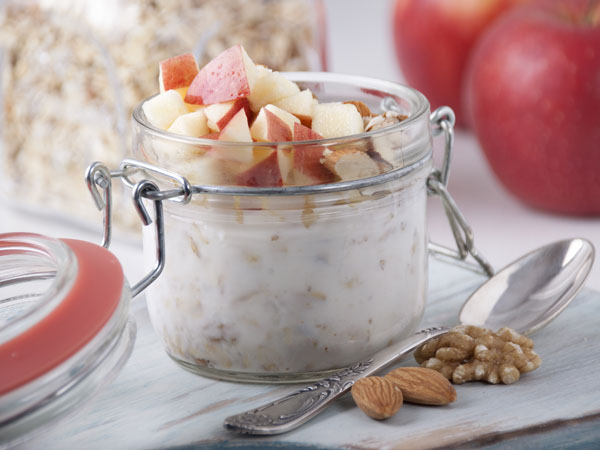
Bircher muesli is made by soaking oats in a liquid overnight, and then adding grated apple and nuts. It will keep in the fridge for about 3 days and can be frozen if required.
Vegan Bircher muesli
Making this soft creamy breakfast vegan is easy. Simply use juice, water or non-dairy milk. Nutty almond milk works particularly well, as does creamy oat milk.
Paleo Bircher muesli
Strictly speaking, the Paleo diet is open to personal interpretation depending on the foods you feel your body can tolerate. But in general, whether they contain gluten or not, grains are eliminated from the Paleo diet. You could experiment with some combination of coconut flakes, almond meal, and chia seeds but the results will be a vague approximation rather than a substitute. We think you are far better off with Paleo muesli or granola of nuts, seeds and fruits instead.
Basic Bircher muesli recipe
Soaked overnight, it becomes a soft and simple moreish thing. For the liquid you could use water, apple juice, milk, or for a touch of luxury, mix of half milk/half cream. The classic nuts would be hazelnuts, but you could use almonds, pecans, or walnuts.
You could make bircher muesli with our multigrain porridge oats, or try a bircher muesli mix instead of just oats.
Serves 1
25g oats
90ml liquid
1 apple, coarsely grated
1/4 cup nuts, chopped
- Mix the liquid with the oats and soak in the fridge overnight.
- Stir in the grated apple.
- Top with the nuts and enjoy.
Have you tried Bircher porridge? Make it just like you would regular porridge, but use a Bircher muesli like our Hinterland Bircher Muesli. It’s ideal for winter and packed full of yummy things that will make your morning porridge a bit more interesting.
Bircher muesli not your thing? Here’s some of our other low sugar cereals. Or head on over to our online gourmet grocery stores where you can buy healthy cereal in bulk.
Fig Apricot Bircher Muesli your Favorite Gourmet Food.
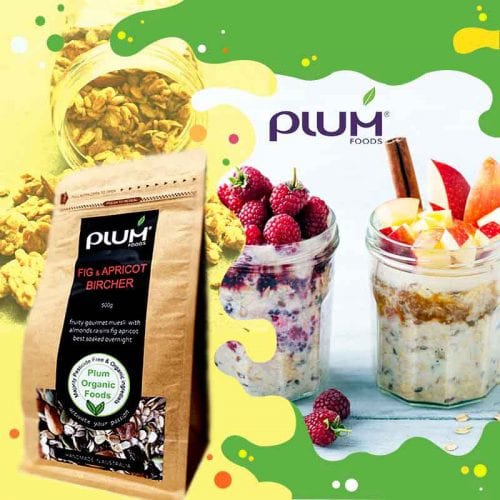
The Fig Apricot Organic Bircher Muesli from the Plum foods is made up of high-quality ingredients. Plum foods use the best quality of natural and organic ingredients. They combine different type of dried fruit and nuts, tasty almonds, healthy cereal, and superb organic oats. It tastes best when soaked in almond milk but you can also try that with the normal milk. You can also have it by cooking it up and then add fresh yogurt or mix them with Acai berry power and add blueberries as toppings.
It is foil lined pack with zipped reseal bag, no artificial preservatives or sweeteners are added to retain its freshness.
Our Fig Apricot Organic Bircher Muesli 500gm is a favorite product among all the gourmet foods found in Plum foods.
If you want to place an order in bulk you can order from our wholesale food Suppliers Sydney, Opera Foods.