
Tag: cereal range for independent supermarkets
How In-Store Tastings Sell Premium Granola for Independent Retailers
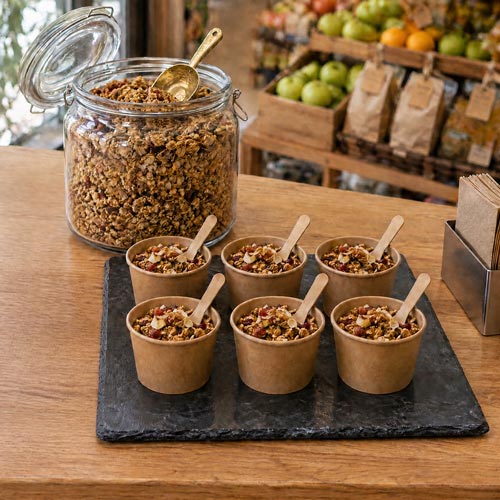
Premium cereal has a communication problem. The eating qualities that set it apart are difficult to convey on a shelf ticket or a pack panel. A shopper can read about toasted grains and restrained sweetness, but those words don’t communicate the crunch or the way clusters hold their texture in milk. A shopper standing in the cereal aisle can read “toasted oats with Australian honey” and still have no real sense of whether this product is worth twice the price of what they usually buy. The description is accurate. It just isn’t the experience.
A tasting does what packaging can’t. Not as a promotional event designed to empty sample cups, but as a way of letting the product make its own case. That changes what you’re measuring and how you judge whether the exercise was worth doing.
The rest of this piece walks through the practicalities of running a premium granola tasting, from choosing a format and managing costs through to measuring whether it actually moved product.
What does an in-store tasting do for premium granola sales?
In-store tastings are often run as miniature sales events. Staff offer samples, shoppers eat them, and success is declared because the cups are empty. But free food is always popular. Empty cups tell you people accepted something at no cost, not that they valued it enough to spend money.
A cereal tasting works differently when you treat it as communication rather than conversion. The purpose is to give a shopper sensory information, the kind that packaging can’t deliver, so they can make their own decision. Some will buy. Others won’t. A few will come back next week once the taste has had time to settle against their usual breakfast. Each of those works, because the tasting answered a question the shelf couldn’t.
Should you serve granola samples dry or with accompaniments?
There are three ways to present a cereal sample: dry, with an accompaniment like milk or yoghurt, or dry with serving suggestions displayed alongside.
Dry tasting is the strongest starting point, and not just because it’s simpler. Tasting cereal on its own isolates exactly the qualities you want the shopper to assess. How the grain tastes, how sweet it is, and how it feels to eat. If someone enjoys the cereal dry, they’ll enjoy it more with their preferred milk or yoghurt. You’re removing a variable.
Adding milk or yoghurt brings the sample closer to how people eat cereal, but it introduces cost, refrigeration, hygiene considerations, and the risk that a good yoghurt does the selling instead of the cereal. For a store running its first tasting, that complexity isn’t justified.
The middle option is to offer dry samples with a small card suggesting “try this with natural yoghurt and seasonal fruit.” That plants the idea without the logistics. It also gives the shopper something to do with the product once they’ve bought it, which is useful.
Should you display ingredients at the tasting station?
Some shoppers won’t taste anything until they’ve read the ingredients panel or checked for allergens. Having that information visible at the tasting station, whether it’s the back of a pack propped up on the table or a printed card with the ingredients list, removes a barrier and signals that the product can withstand scrutiny. For a premium cereal made from recognisable ingredients, that transparency works in your favour.
If you’re tasting a range of three or four products side by side, as Plum’s cereal range allows, labelling each sample with its variant name and key ingredients helps shoppers make comparisons. A tasting with variety is more engaging than a single-product sample, and it lets different shoppers find the product that suits them rather than presenting one option as the answer for everyone.
How much does a granola tasting cost to run?
A tasting portion is a tablespoon or two, enough to assess flavour and texture but not enough to constitute a snack. The economics are straightforward. A single retail pouch yields a significant number of tasting portions at that size, which means the cost per portion is modest. Work out how many portions you’ll serve in a session, multiply that by the per-portion cost of the product, and you have your investment. How many additional packs would you need to sell to recover that cost? For most premium cereals, the answer is a small number.
Running that arithmetic before the tasting, rather than after, sets a realistic threshold. You’re asking whether a few incremental sales, above what you’d normally move, justify the product and the labour.
Where should you put the tasting station in store?
In a store the size of most independents, the tasting doesn’t need a dedicated station. A staff member with a sample tray near the cereal aisle is enough. If there’s room, a small table at the end of the aisle works well. If there isn’t, samples on the counter near the register with a few retail packs displayed alongside achieve the same thing.
What matters is that the product is easy to find once someone has tasted it. If a shopper has to go looking for the pack, you’ve added a step where they can talk themselves out of the purchase.
When is the best time to run an in-store tasting?
Weekend mornings are the obvious choice. Foot traffic is higher, shoppers browse longer, and fewer people are in a rush. But weekday sessions targeting retirees or parents shopping during school hours can work well too. These shoppers tend to have more time to stop, taste, and read the information you’ve put out. The audience you reach affects what a successful tasting looks like. A weekday session might generate fewer total interactions but a higher proportion of considered purchases.
A single session of two to three hours is enough to test the format. Running it across two or three weekends gives you a more reliable read on whether the tasting is lifting sales or simply redistributing purchases that would have happened anyway.
How do you measure whether a tasting worked?
The measure isn’t cups consumed. Its units sold compared to normal trading.
Pull the sales data for the tasted products over the same days of the week in the preceding few weeks. That’s your baseline. Then compare. Did units increase during the tasting period? Were sales still elevated in the week or two after, suggesting that some shoppers came back for a repeat purchase? And did adjacent products in the range also lift, even if they weren’t part of the tasting?
Be honest with the data. A single tasting in a single store is a small sample. You’re looking for a signal. If sales doubled on tasting day but returned to normal immediately, the tasting generated curiosity but not repeat buyers. If sales lifted modestly but held for a fortnight, that’s a more convincing result, even if the numbers are smaller.
The measure isn’t whether the tasting was popular. It’s whether more people bought than would have without it, and whether that uplift justifies the cost. If the answer is yes, you’ve found a format worth repeating. A marginal result is worth adjusting before you write it off. Try a different day, a different location in the store, or a different selection from the range. A clear miss saves you from repeating an exercise that doesn’t work.
How can independent retailers get started with granola tastings?
If you want to test the format before committing to a full programme, we can help. Plum Foods supplies sample stock and retail-ready packs in low minimum quantities, enough to run a first tasting without overcommitting on inventory. Request wholesale pricing and samples through our wholesale granola page for independent retailers to get started.
This article was reproduced on this site with permission from operafoods.com.au the “Wholesale Granola Supplier”.
See original article:- How In-Store Tastings Sell Premium Granola for Independent Retailers
Building a Cereal Range for Independent Supermarkets When Value Outpaces Demand

Australian breakfast cereal is not growing. The retail value of the category has risen, but that rise is driven by higher unit prices, not by more people buying more cereal. Some shoppers are responding by switching to private label or skipping the category altogether.
If you run an independent supermarket, that changes what your cereal shelf needs to do. When demand is growing, you can afford to add products and expect returns. When it is not, every new line either takes a sale from something you already stock or goes unsold. The question is whether your cereal range is structured to make the most of it.
The framework that follows starts with six commercial roles a cereal can play on an independent supermarket shelf. It then uses those roles to diagnose where a cereal range is duplicating itself and where a slow seller may be earning its keep. The final step is filling genuine gaps, and what it looks like when one supplier’s range is built this way.
Why does adding more cereal products not lead to more sales?
In a flat category, most new products take sales from lines already on the shelf rather than bringing in new customers. The natural response to stagnant demand is to try to capture more of it. Stock a premium granola because premium is where the value growth sits. Add a lower-sugar option because health positioning is trending. Bring in a keto line because the dietary segment is growing faster than mainstream. Each addition makes sense in isolation.
But lay them out together and ask what each one is offering the customer. Three granolas at a similar price point, making the same health claims, targeting essentially the same shopper. The third is not expanding your range. It is diluting the first two. You have more products on the shelf and no more customers to buy them.
This is not an argument for stripping back to mainstream staples. Several products from one specialist supplier can add more useful choice than several near-identical products from different brands. The discipline is knowing whether each product does a job that nothing else on the shelf is already doing.
What roles should cereals play in an independent supermarket range?
Every cereal on an independent supermarket shelf is there to do a commercial job. The useful test is whether you can identify that job for each product, not by brand or by supplier, but by the role it plays for your customer. Most fall into one of six.
Value anchor
This is the product that stops your cereal section looking uniformly expensive. The ACCC’s supermarket inquiry found that 69% of surveyed consumers always or usually compared prices between similar products. Consumers specifically raised concerns about cereal pricing and shrinking pack sizes. Your value anchor does not have to be the cheapest cereal on the market. It must make the entry price into the category clear and defensible, so a price-conscious shopper does not walk past the whole fixture.
Family staple
This is the cereal people expect to find. It is bought on routine, not on discovery. It will not differentiate your store, but it stops your regular customers going elsewhere to finish their shop. You may need more than one, but each should serve a recognisably different household. Two brands making the same proposition to the same family are not two staples. They are one, taking up two facings.
Premium trade-up
This is the product that gives a shopper a reason to spend more. The reason must be visible. A distinctive recipe, genuine ingredient quality, or a process that separates it from the mainstream product beside it. If all that distinguishes it is the price and the packaging, it is not a trade-up. It is a more expensive duplicate. A gourmet granola, a Bircher muesli, and a specialist blend can each function as a trade-up without competing, as long as each one answers a different question.
Dietary solution
Whether the need is gluten-free, keto, or high-protein, a dietary solution solves a genuine problem for a specific customer. The test is whether the product serves someone your mainstream range cannot, or whether it restates a proposition you are already covering. A gluten-free shopper and a keto shopper need different formulations. Two products that both lead with “high protein” and target the same person are one dietary solution, not two.
Hot-cereal option
Hot cereal covers a different breakfast occasion from anything ready-to-eat, and hot cereals have recorded stronger historical growth than the ready-to-eat segment that still dominates Australian sales. That does not mean stocking every oat variation on the market. It means treating porridge and oats as a deliberate choice rather than something that ended up on your shelf by default.
Destination product
This is the cereal someone comes to your store to buy. It is the one they cannot find in the major chains. It might be Australian-made, specialist, or simply not available elsewhere. A destination product should not be judged purely on unit sales against a national brand. Its value may sit in the margin it delivers, the repeat visits it drives, and the reason it gives a customer to choose your store over theirs.
These roles are not rigid shelf segments, and one product can serve more than one. A premium Australian-made granola might be both a trade-up and a destination product. A specialist dietary line might also be the product a customer cannot find elsewhere.
How do you spot duplication in a cereal range?
Map your current cereal range by role instead of by brand and the picture changes. Products that look different when you sort them by supplier can look almost identical when you group them by who they are for, what they cost, and what they promise. The reverse is also true. Two products from the same brand may turn out to serve entirely different customers.
Ask yourself: if one of these SKUs disappeared tomorrow, would you lose a customer? Or would that purchase simply shift to the product beside it? If the answer is the latter, you are carrying inventory and using shelf space for a sale that would have happened anyway.
How do you assess whether a slow-selling cereal is worth the shelf space?
A slow-selling specialist cereal and a slow-selling mainstream duplicate are not the same problem, and they should not be treated the same way. The specialist may sell fewer units while producing better margin per pack. It brings in a shopper who buys yoghurt and fruit alongside it and gives your store something the supermarket down the road does not have. The duplicate may have acceptable volume but contribute nothing your range was not already doing. It just splits the same sale across two facings.
When you review a product’s contribution, consider whether it is selling because it offers something distinct or because it happens to be there. Consider the basket it sits in, not just its own line. And be honest about whether a product that sells slowly is slow because it serves a small but real need, or slow because it adds nothing a customer would notice.
How should independent supermarkets fill gaps in their cereal range?
Not every blank space in a product grid is a gap that needs filling. A genuine gap is unmet demand, meaning a customer you are losing or a commercial role your fixture is not performing. An unfilled flavour or an emerging trend is not, by itself, a reason to order.
Once you have mapped your cereal range by role, missing jobs tend to become obvious. You might have family staples and dietary products but no credible premium trade-up. You might have a broad mainstream selection but nothing a customer would call a destination product.
Define the purpose before you order. Measure each product against the job you brought it in to do. A trade-up that is not generating sales above the mainstream price tier is not functioning as a trade-up. A dietary solution that gets judged against the volume of a family brand it was never meant to compete with is being measured against the wrong benchmark.
To understand why a destination cereal earns its space through repeat visits rather than volume, read how specialty cereal for independent retailers turns a single sale into a weekly visit.
Can one cereal supplier fill multiple range roles?
A single supplier can fill multiple range roles when each product serves a genuinely different need. A deliberately selected group of cereals from the same manufacturer earns its shelf space by filling roles that nothing else in the range covers.
Plum Foods, manufactured by Opera Foods in Australia, is a range designed around this principle. It spans premium granola, dietary-specific formulations including gluten-free and keto, Bircher muesli as an alternative format, and five-grain porridge for the hot-cereal occasion. Each product addresses a different customer at a different price point. The range is built for role differentiation, not shelf proliferation.
Opera Foods sells direct to independent retailers. Buying from the manufacturer rather than through a distributor changes the margin structure, which matters when a product is assessed on contribution rather than volume alone.
A cereal range built on role differentiation rather than variety is how independent supermarkets make a flat category work harder. Request pricing and samples from the Plum Foods cereal range for independent supermarkets.
This article was reproduced on this site with permission from operafoods.com.au the “Retail Granola Supplier”.
See original article:- Building a Cereal Range for Independent Supermarkets When Value Outpaces Demand