
Author: Anna
Can you eat granola on keto?
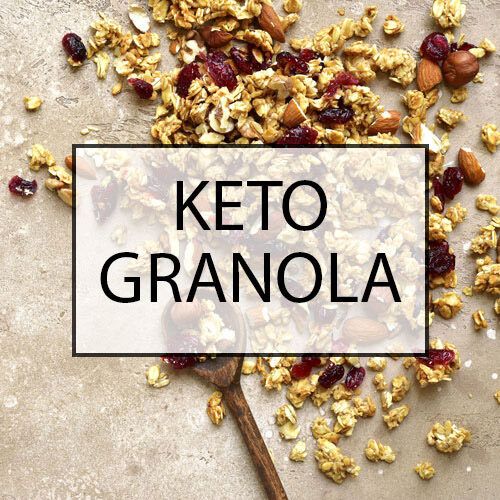
We all know that cereals are carbs, right? And that carbs are the enemy of ketosis. But can you eat granola on keto?
What is the keto diet?
Keto is short for ketogenic. The keto diet is a very low-carb, high-fat diet that may help you lose weight and benefit your health.
How does the keto diet work?
As the name suggests, the aim of the keto diet is to put your body in ketosis. A metabolic state that enables the body to become more efficient at burning fat for energy, ketosis is said to reduce blood sugar and regulate insulin levels. In ketosis, your body uses fat for fuel instead of carbohydrates, yet normally the metabolism relies on glucose for energy. Limiting intake of carbs reduces the availability of glucose, causing the metabolic pathways to shift direction and burn fat for energy instead.
Keto macros
The principles behind keto are not quite as simple as just reducing carbs. Successful ketosis relies on a ratio of macronutrients that will not only be slightly different for each individual but will also alter over time and according to changing variables. Measuring the macronutrients of carbs, protein and fat ensures optimal calorie intake but also affects the equilibrium of ketosis. You can start your keto diet on a certain ratio but from there it is all about observation and fine-tuning.
The standard ratio for keto is 10% carbs, 20% protein, 70% fat. Guidelines recommend levels between: 5-10% carbs, 15-30% protein, 60-75% fat.
Although foods are generally classed in groups according to the main macronutrient, most (if not all) foods contain a proportion of each. So, when calculating, the entire macronutrient composition must be taken into account.
How many carbs per day on keto?
To get from a percentage to a usable measurement, such as grams, you need to do some calculations based on your overall daily calorie target. You also need to know that carbs provide 4 kcal energy per gram.
For instance, on 2000 kcal a day, 10% carbohydrate would be 200 kcals. Divide 200 by 4 and you get a carb goal of 50g per day. When calculating carbs, you need to use the figure for net carbs, as oppose to total carbs. The numbers for net carbs do not include fibre, as this is not absorbed by the body and therefore provides no energy. On the other hand, the numbers for total carbs include the grams of fibre.
Healthy fats for keto
A successful keto diet is as much about quality as it is quantity. A diet based around whole natural foods, with a focus on nutrient density and macronutrients is as important on keto as any other eating plan.
Whilst saturated fats are accepted as vital sources of nutrients, there are a wide range of plant-based fats that support overall health. Nuts and seeds, and their derivative oils, as well as coconut oil and olive oil are all healthy fats for a keto diet.
How much protein on keto?
It can be easy to get too much protein on a keto diet. When you eat too much protein it may inhibit ketosis as the body can convert amino acids (the building blocks of protein) into glucose. As protein releases the same amount of energy as carbohydrates, the calculation for optimal intake is the same. Again, nuts and seeds are recommended sources on the keto diet. A pretty much perfect food, they are low in carbohydrate, and high in protein as well as healthy fats.
Did you know that almonds are one of the most versatile nuts for a keto diet?
Keto breakfast
Breakfast is hard enough when you are gluten-free, but low-carb? A potential minefield.
Nutritionally speaking, the best foods for a healthy breakfast are believed to be grains, dairy and fruit, and the benefits of cereal and milk are widely accepted. Eggs are the go-to ingredient for a keto breakfast, closely followed by pork products such as bacon and sausages. But what if you want a keto breakfast with no eggs? What if you are mindful of saturated fat and excess protein? Not to mention sodium. It’s an Atkins nightmare all over again. And then there is time. Or not. Very few people can manage to cook, let alone eat, a hot meaty breakfast before heading out the door in the early morning. Sure, where there’s a will there’s a way but that’s why breakfast cereal was invented yeah? Convenient, crunchy, and easy on the digestion.
Keto cereal
Breakfast cereal is generally made from grains. Aka cereals. Aka carbs. Which of course are a big nay-nay for the fat-burning bod.
What cereal can you eat on the keto diet?
Some breakfast cereals are lower in carbs than others yet will still use up your entire weekly carb allowance in one glorious bowl. The market has got wiser as far as individual dietary preferences are concerned and the available range is far wider than it once was. You do need to check your labels carefully though. Grain-free is your best bet, but may come with whopping amounts of sugar. Better still would be a breakfast cereal labelled keto. Imagine that 😉
Can you eat granola on keto?
The short answer is pretty much no. But keto granola does exist. Based on nuts and seeds, with a handful of healthy fat thrown in, keto granola is just the thing for a cold and crunchy keto breakfast.
Try Almond Blueberry Keto Granola which is also a Gluten free Vegan granola. Check out our article ‘muesli vs granola’ for a comparison of the two.
Can you have milk on a keto diet?
But what about the milk? It is that combo of cold cold milk and crunchiness that makes granola such a lovely thing. Can you have milk on a keto diet?
Dairy milk, from cows or goats, might be chock full of nutrients including protein and fats, but they also come with a moderately high amount of carbs. One cup of cows milk has 12g net carbs. Goats milk has marginally less.
And it is not just dairy. Many alternative milks come with a ton of carbs too. Oat milk (unsurprisingly) has 17g net carbs per cup. Rice milk is even higher at 21g.
Also unsurprisingly, almond milk is THE milk of choice for keto, with just 1g of carbs per cup. Yay. If you make your own almond milk it tastes better and has no sweeteners of fillers that you didn’t put there yourself.
What about keto-friendly fruit?
A bowl of granola needs a bit of fruit, but unfortunately this is also a keto minefield. Our advice is to go for berries, some of the lowest carb fruit around. At between 6-9g carbs in half a cup of raspberries, strawberries, or blueberries, they certainly aren’t for everyday but make an excellent nutrient boost to breakfast a few times a week.
Watch out for our keto granola coming soon…
In the meantime, check out our other low sugar granola or buy healthy cereals at wholesale prices from our online bulk food store.
This Article was reproduced with permission from Opera Food’s article:- “Can you eat granola on keto?” dated 22nd June 21
The benefits of cereal and milk for breakfast
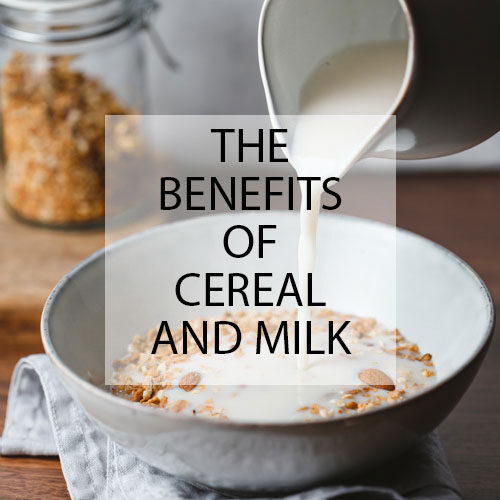
The benefits of cereal and milk for breakfast, with a portion or two of fruit added, are widely accepted within the nutritional community.
In our article ‘what is a healthy breakfast‘ we saw that a healthy breakfast is composed of –
A 30g serving of wholegrains
A 150g portion of fruit
A 250ml serving of milk
So, it is all good to go on that granola!
Why are cereals important in our diet?
The question of the importance of cereals in our diet is a divisive one. Partly carbohydrate conundrum, with issues of gluten involved, and concern over phytic acid thrown in, the eating of grains is certainly a contentious topic. Largely, we agree on the fact that over-consumption of refined grains can lead to health problems. Yet there are many benefits associated with wholegrains.
Wholegrains are the seeds of grass type plants called cereals. Rice, wheat and sorghum are all grains. Buckwheat and quinoa are pseudo-cereals. Intact, with minimal processing, they contain a wide range of minerals, vitamins, fibre, fat, protein and carbohydrate.
A regular diet of wholegrains may help to lower the risk of heart disease and stroke and regulate blood sugar levels. Wholegrains are excellent for digestive health because they are full of fibre. Grains are also a comparatively low cost food, providing bulk to our diet.
Gluten-free cereal
For those of us with coeliac disease or gluten intolerance it can be simpler to avoid eating grains altogether but there are gluten-free grains out there. Which makes it possible to find gluten-free granola. Yay!
Sorghum and rice are both true grains that are gluten-free. Buckwheat and quinoa are not true grains, although they are gluten free.
Is quinoa a cereal grain?
Quinoa is technically not a grain but a seed belonging to a family of leafy plants, not grasses. By definition, cereal grains belong to the family of plants known as grasses. However, quinoa is generally grouped together with wholegrains and is an excellent gluten-free grain alternative. As well as being free of gluten, quinoa is high in protein and a great source of all nine essential amino acids. It also provides fibre, iron, vitamin E, potassium, calcium, magnesium and phosphorus.
Is granola cereal?
Granola is one of the most popular breakfast cereals around. Made from cereal grains it most certainly classifies as cereal. Often made with oats as a base, granola is now available in many forms beyond the classic oat/fat/sugar scenario. One of our most popular varieties is a gluten-free granola made with quinoa, rice, sorghum and buckwheat.
Buckwheat cereal
As a gluten-free option, cereal made from buckwheat is becoming increasingly popular. Like quinoa, buckwheat is actually a seed. It has a robust nutty flavour with a slightly bitter undertone and is, in fact, what soba noodles are made from.
Is cereal with almond milk healthy?

Although nutritionists agree on the benefits of cereal and milk for breakfast, and that dairy forms an important part of that particular nutritional combo, there is an increasing number of people turning to non-dairy milks such as almond milk. Commercial almond milk often has added ingredients in the form of fillers and preservatives. It can also have added sugar. It is however easy enough to make your almond milk at home with just almonds and water. Many shop-bought almond milks do have the benefit of being fortified with calcium and Vitamin D. Chipped and broken grades of Almonds can be a perfect way to buy these highly nutritional nuts for food ingredients where presentation of the kernel is not important.
Low-sugar cereals
The nutritional quality of your breakfast not only depends on choosing wholegrains but also making sure that you only opt for low-sugar cereals too. Many brands of wholegrain cereal will be full of added sugar, so again it is a matter of reading the label carefully.
Vegan cereal
Many cereals are vegan. Look for good quality varieties and always read the label. You can find out here what goes into the best granola. Usually it is the choice of milk that determines how vegan your breakfast is so stick with something like almond milk and you are good to go.
How much cereal should you eat for breakfast?
The recommended portion of cereal is 30g. The only way to be accurate with this is to weigh it. If you stick to the same cereal you can measure your weighed portion of cereal so that you do not need to weigh it every time. For a new cereal though, it is best to weigh it out.
Does eating cereal make you gain weight?
You shouldn’t gain weight by eating cereal if you stick to the recommended portion size and always choose low-sugar varieties. There is some evidence that cereal can help to control weight. If it has plenty of fibre it can help to fill you up and satiate hunger, as well as control blood sugar levels and aid insulin resistance. It is also suggested that magnesium can help to burn calories more efficiently.
We have many healthy breakfast cereals to choose from and all of our muesli and granola is available to buy in bulk.
What is Bircher muesli and how easy is it to make?
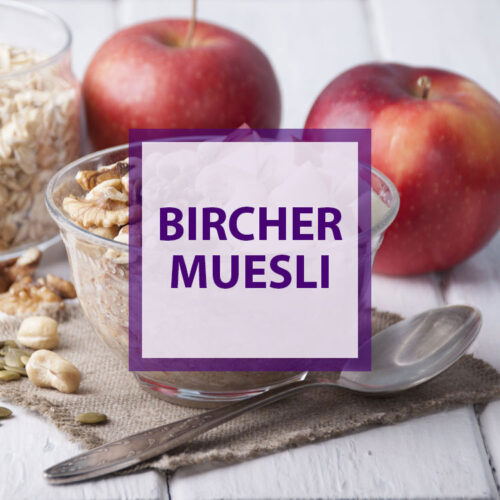
The forerunner to overnight oats, Bircher muesli is a healthy breakfast favourite.
The soaked oats take on a softly different texture to porridge, in a dish that is easy to eat and easy to digest. Which is ideal for the first meal of the day.
Closely related to both muesli and granola, it can be oddly decadent in spite of its wholesome credentials.
What is Bircher muesli?
Bircher muesli was created in the early 1900s by Maximilian Bircher-Brenner. A Swiss doctor, he created the recipe as a way of getting more fruit into his patients. More specifically, apples, which he considered particularly nutritious. A simple recipe of oats, milk, nuts and apples soaked together overnight, it was a soft and easily digestible breakfast for his sanitorium patients. So of course Bircher Muesli is another one of the low sugar cereal products.
Is Bircher muesli healthy?
Like most foods, it can only be as healthy as the ingredients that you make it with. Made with cream and lots of nuts it will be more heavy on calories than if you soak it in water. Made with the four basic ingredients, this healthy breakfast comes with a range of benefits.
Oats are full of fibre, some of which is soluble, that gives an extended feeling of fullness and prevents blood sugar spikes. Magnesium present in oats helps to regulate insulin secretion and they also contain a natural sedative. With plenty of vitamins and minerals, oats are a great source of all round goodness.
Maximilian was right about apples; an often overlooked fruit. They also help to regulate blood sugar levels and are a source of soluble fibre. Many of the compounds found in apples improve metabolic balance. Always eat the skin as it contains fibre and may help prevent osteoporosis. Apples are waxed for shelf life, so wash them thoroughly in warm soapy water and rinse well before eating. Allowing the apple to brown a little after grated can help it become more easily digestible. Apples are also a source of vitamin C and iron.
Adding nuts increases the protein content as well as the fibre. Always eat nuts with the skin on to keep the nutrient profile intact. Nuts also provide many essential fatty acids. Almonds are rich in zinc, magnesium, and potassium as well as antioxidant vitamin E. Hazelnuts are rich in antioxidants and contain biotin, a substance that is really good for strong healthy skin and hair.
Using dairy milk, from cows, sheep, or goats, adds the benefit of calcium and vitamin D. Dairy foods also provide vitamin B12 which is essential for a healthy brain and nervous system. Vitamin B3 in dairy milk can also help to burn more calories. Choose full fat milk as it retains the fat soluble vitamins A, D, E and K.
Can you eat Bircher muesli without soaking?
Bircher muesli by default is soaked. Not soaked, it becomes, well, muesli. The soaking process not only makes the oats more digestible by softening them, but helps to break down a substance called phytic acid. Present in all grains (which is why grains are not part of a Paleo diet), phytic acid binds to certain minerals and reduces the uptake of minerals present in the food. You can also include the nuts in the soaking process for the same reason, but they do take on a softer less crunchy texture.
Is Bircher muesli gluten free?
Oats themselves are not gluten free yet low in gluten and are often processed alongside wheat and other cereals so tend to be avoided by those with serious issues around gluten, such as coeliacs. Oats that are not 100% gluten free although some are labelled as such, and some commercial muesli blends will contain other gluten-containing cereals.
How to make Bircher muesli
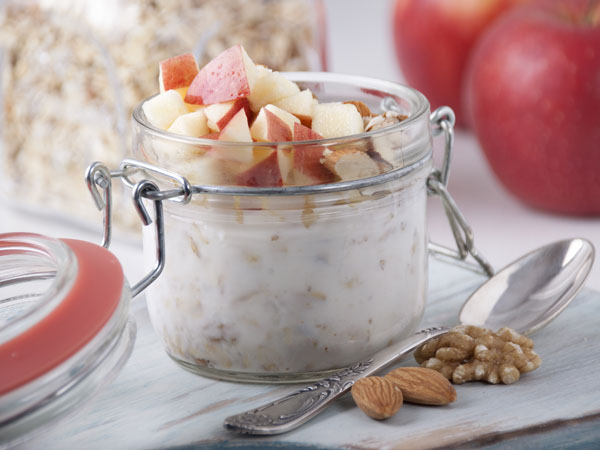
Bircher muesli is made by soaking oats in a liquid overnight, and then adding grated apple and nuts. It will keep in the fridge for about 3 days and can be frozen if required.
Vegan Bircher muesli
Making this soft creamy breakfast vegan is easy. Simply use juice, water or non-dairy milk. Nutty almond milk works particularly well, as does creamy oat milk.
Paleo Bircher muesli
Strictly speaking, the Paleo diet is open to personal interpretation depending on the foods you feel your body can tolerate. But in general, whether they contain gluten or not, grains are eliminated from the Paleo diet. You could experiment with some combination of coconut flakes, almond meal, and chia seeds but the results will be a vague approximation rather than a substitute. We think you are far better off with Paleo muesli or granola of nuts, seeds and fruits instead.
Basic Bircher muesli recipe
Soaked overnight, it becomes a soft and simple moreish thing. For the liquid you could use water, apple juice, milk, or for a touch of luxury, mix of half milk/half cream. The classic nuts would be hazelnuts, but you could use almonds, pecans, or walnuts.
You could make bircher muesli with our multigrain porridge oats, or try a bircher muesli mix instead of just oats.
Serves 1
25g oats
90ml liquid
1 apple, coarsely grated
1/4 cup nuts, chopped
- Mix the liquid with the oats and soak in the fridge overnight.
- Stir in the grated apple.
- Top with the nuts and enjoy.
Have you tried Bircher porridge? Make it just like you would regular porridge, but use a Bircher muesli like our Hinterland Bircher Muesli. It’s ideal for winter and packed full of yummy things that will make your morning porridge a bit more interesting.
Bircher muesli not your thing? Here’s some of our other low sugar cereals. Or head on over to our online gourmet grocery stores where you can buy healthy cereal in bulk.